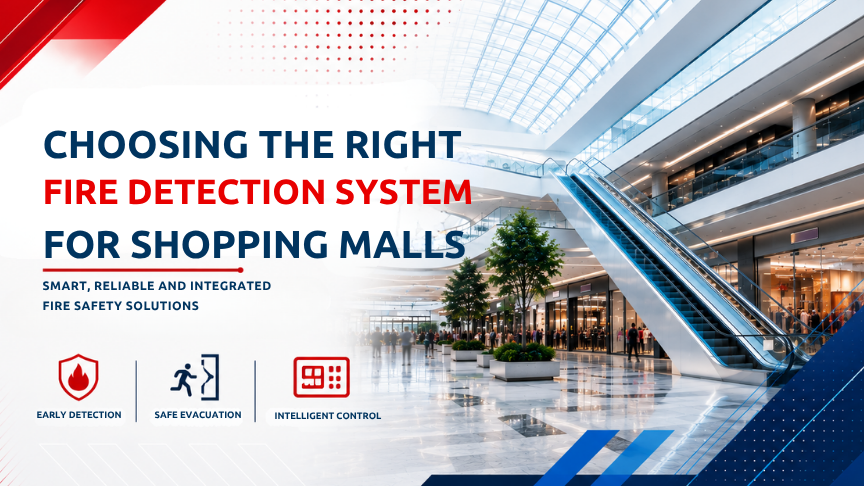
Shopping malls are among the most complex commercial buildings in terms of fire safety. Thousands of visitors, multiple retail stores, food courts, cinemas, entertainment areas, underground parking garages, and technical rooms all operate within a single facility. Each of these spaces presents different fire risks and requires a carefully engineered fire detection strategy.
Unlike office buildings, shopping malls accommodate a constantly changing population. Many visitors are unfamiliar with the building layout, making early fire detection and safe evacuation even more critical. A properly designed fire alarm system not only detects fire quickly but also helps direct occupants safely toward emergency exits while supporting emergency response teams.
Modern shopping malls therefore rely on integrated fire protection solutions rather than standalone fire detectors. Addressable fire alarm systems, intelligent detectors, beam smoke detectors, emergency voice evacuation systems, and emergency lighting all work together to maximize life safety.
Shopping malls combine many different occupancy types under one roof.
Retail stores, restaurants, cinemas, children's entertainment areas, supermarkets, technical service rooms, electrical rooms, and parking garages all have different environmental conditions and fire risks.
A single detector type cannot provide optimum protection throughout the entire building.
Instead, each area should be evaluated individually during the fire protection design process to ensure the most appropriate detection technology is selected.
This risk-based approach improves detection speed while reducing unwanted alarms.
Several factors contribute to fire risks in shopping malls.
Electrical faults remain one of the most common ignition sources.
Commercial kitchens and food courts introduce additional hazards through cooking equipment, grease accumulation, and high temperatures.
Retail storage rooms often contain combustible cardboard packaging, textiles, plastics, and display materials that can accelerate fire growth.
Mechanical rooms, HVAC equipment, generators, and electrical distribution panels also require continuous monitoring.
Understanding these different hazards is essential when selecting fire detection equipment.
Large commercial buildings require accurate information during an emergency.
Addressable fire alarm systems identify the exact detector or device that has activated instead of indicating only a general alarm zone.
Security personnel can immediately identify the affected store, corridor, or technical room, significantly reducing emergency response time.
Maintenance also becomes more efficient because system faults can be located quickly without inspecting large portions of the installation.
For shopping malls containing hundreds of devices, addressable technology provides both operational and safety advantages.
Modern shopping malls often feature large atriums with high ceilings designed to create open, attractive public spaces.
However, these architectural features create challenges for conventional point smoke detectors.
Beam smoke detectors monitor long distances by transmitting an infrared beam between a transmitter and receiver.
Because they cover large open spaces efficiently, they are commonly used in atriums, exhibition halls, airports, logistics centers, and shopping malls.
Their wide coverage also reduces installation complexity and maintenance requirements.
Different areas within a shopping mall require different detection technologies.
Optical smoke detectors are commonly used in retail stores, corridors, and public spaces.
Heat detectors are more suitable for commercial kitchens where cooking vapors could otherwise generate unwanted smoke alarms.
Parking garages often benefit from integrated gas detection systems that monitor carbon monoxide and other hazardous gases.
Proper detector selection minimizes false alarms while ensuring reliable fire detection.
Detecting a fire is only the beginning of the emergency response process.
Occupants must receive clear and immediate notification.
Audible alarm devices warn visitors throughout the building, while visual alarm devices improve awareness in noisy environments and support occupants with hearing impairments.
Large shopping malls frequently integrate voice evacuation systems that provide spoken evacuation instructions, reducing panic and improving crowd management.
These systems become particularly valuable during peak shopping hours.
Visitors cannot evacuate safely if they cannot identify emergency exits.
Emergency lighting systems automatically operate during power failures, ensuring that escape routes remain visible.
Exit guidance luminaires direct occupants toward safe exits, while predefined evacuation scenarios coordinated by the fire alarm control panel help avoid unnecessary congestion.
Well-planned evacuation strategies significantly improve overall building safety.
Fire alarm systems require continuous maintenance throughout their service life.
Shopping malls operate daily under changing environmental conditions that can affect detector performance.
Dust accumulation, building modifications, tenant changes, and equipment aging may reduce system reliability if maintenance is neglected.
Routine inspections should include detector testing, control panel verification, battery testing, communication loop checks, sounder testing, and system reporting.
Preventive maintenance ensures reliable operation when a real emergency occurs.
Finder provides integrated fire detection solutions suitable for shopping malls and other large commercial facilities.
Its product portfolio includes:
Together, these technologies provide early fire detection, reliable notification, safe evacuation, and efficient maintenance for shopping mall environments.
Selecting the right fire detection system for a shopping mall requires much more than installing smoke detectors.
Every area within the building has unique fire risks that require appropriate detection technologies.
By combining addressable fire alarm systems, beam smoke detectors, intelligent notification devices, emergency lighting, and preventive maintenance, shopping malls can significantly improve life safety while protecting valuable commercial assets.
A professionally engineered fire detection system is one of the most important investments in the long-term safety and operational continuity of any shopping mall.
Why are addressable fire alarm systems preferred in shopping malls?
Addressable fire alarm systems identify the exact device that triggered the alarm, enabling security teams to respond quickly and accurately in large commercial buildings.
Which fire detectors should be used in shopping malls?
Shopping malls typically use a combination of optical smoke detectors, heat detectors, beam smoke detectors, and gas detection systems depending on the specific area and fire risk.
Where are beam smoke detectors commonly installed in shopping malls?
Beam smoke detectors are ideal for atriums, high ceilings, large corridors, exhibition spaces, and other wide open areas.
Why are different detectors used in food courts?
Cooking vapors and grease particles may cause unwanted smoke alarms. Heat detectors are generally preferred in commercial kitchens to reduce false alarms.
Are voice evacuation systems necessary in shopping malls?
Voice evacuation systems help guide visitors calmly toward emergency exits, improving crowd management and reducing panic during emergencies.
Why are emergency lighting and exit guidance systems important?
Emergency lighting and exit guidance systems keep escape routes visible during power failures and help occupants evacuate safely.
How often should shopping mall fire alarm systems be maintained?
Routine preventive maintenance should include detector testing, control panel inspection, battery testing, notification device verification, and communication loop testing.
What fire safety solutions does Finder provide for shopping malls?
Finder provides addressable fire alarm systems, wireless fire alarm systems, beam smoke detectors, optical and heat detectors, EN54-certified sounders and visual alarm devices, gas detection systems, and emergency guidance solutions.
 TR
TR