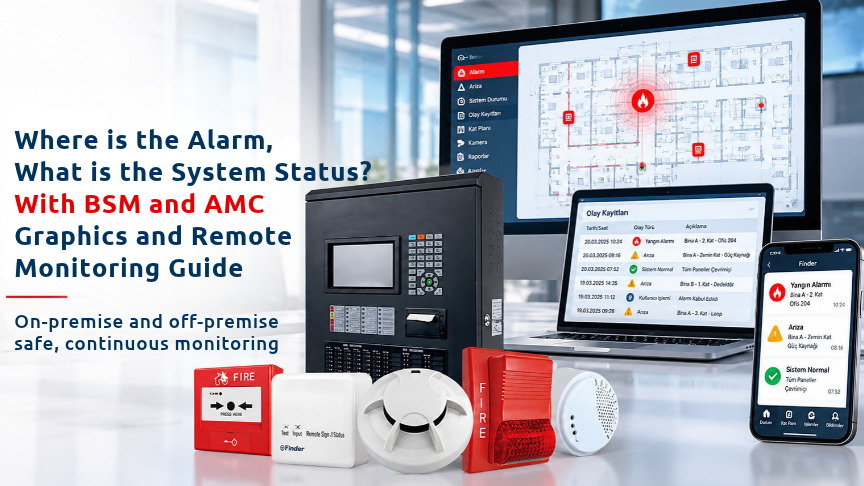
When a fire alarm occurs, displaying only “alarm active” is not sufficient. Panel, loop, address, building, floor and location information should be available quickly and the event should be recorded. The specification addresses this requirement through Graphic Monitoring Software (BSM) and the Remote Fire Alarm Monitoring System (AMC).
BSM covers real-time monitoring of panels and field devices through a server-client architecture, alarm/fault management, graphic location display and log reporting. AMC covers off-site monitoring by smartphone and computer, instant notifications and communication through a field data modem.
The most important design boundary remains unchanged: graphic or remote monitoring software does not replace the mandatory EN 54-2 functions of the fire alarm control panel. If the software, server or communication link becomes unavailable, the panel must continue operating independently and detection, alarm and evacuation functions must remain active.
|
Topic |
BSM – Graphic Monitoring |
AMC – Remote Monitoring |
|
Use |
On-site monitoring and control through server and client applications |
Off-site monitoring by smartphone and computer |
|
Main function |
Live status, alarm/fault management, graphic monitoring and logs |
Remote alarm/fault notification and point-based location |
|
Communication |
TCP/IP-based local network between server and client |
Ethernet and Wi-Fi through a field data modem |
|
Camera |
IP cameras can be integrated into the same interface |
The specification does not define camera support for AMC |
|
Location |
100% vector AutoCAD floor plans for BSM |
The AMC section states that it can operate without a vector building drawing |
The draft contains two different statements regarding AMC location display. The comparison table refers to a vector plan, while the AMC section states that the system can operate without a vector building drawing and can report the location by building, floor, room and address. This point should be clarified against the main specification.
The user interface is required to be in Turkish. Alarm, fault and event messages are displayed in Turkish, although message content may appear in English depending on the panel protocol. The software is defined for Windows 10 64-bit and later operating systems.
BSM consists of server and client applications that can operate independently. The server communicates with the fire alarm panels, stores event records in the database and runs defined scenarios. The client connects to the server over the network for monitoring and control.
The server and client may run on the same computer or on separate computers. Multiple clients can connect to the server simultaneously. Where AMC is included, monitoring can also be performed by smartphone and tablet.
All connected panels should be monitored in real time. The main screen should display overall system status as an event-based log list. Users should be able to switch between panel-based list and graphic views. Devices should be searchable by panel and loop, and a communication interruption between the panel and software should appear as a separate warning.
For BSM, the specification requires floor plans to be 100% vector AutoCAD drawings. Scanned or raster-based plans are not accepted for the BSM graphic display.
During installation, the contractor imports floor plans, places field devices at their actual positions and defines the required scenarios. When an alarm or fault occurs, the relevant location should open automatically on the vector drawing and be visually highlighted.
The objective is to allow the operator to see not only a device address but also the actual location of the event in the building. Panel, loop, address, floor and location information should be presented together.
The AMC section states that AMC can operate without a vector building drawing and can report the alarm location as point-based building, floor, room and address information.
When an alarm or fault occurs, the relevant location should open automatically on the graphic display and be highlighted visually. A fire alarm should generate an audible warning. The operator's acknowledge or silence action should be recorded with username and timestamp.
If several alarms occur at the same time, every alarm should be displayed in a list so that no event is overlooked.
Alarms, faults, resets and user actions are stored in the database with date and time stamps. Records can be filtered by date range, panel, loop, address, event type and user. User actions and connection status can be queried separately.
Results can be printed or exported, and the log screen can be exported as CSV. Event records cannot be deleted or modified by users.
Access is controlled by username and password. At least three authorisation levels can be defined. The panels each user may monitor and the commands they may issue can be configured separately.
Monitoring and control permissions can therefore be separated. The specification also requires users to log in again 30 days after login.
User operations are stored with username and time information, allowing acknowledge and silence actions to be traced.
Historical data is backed up automatically every week in SQL file format. Backups can be stored on external media or at another network location.
In BSM, the fire alarm system and IP camera system can be integrated into the same interface. When a fire alarm occurs, the live feed from the IP camera assigned to the alarm device can be displayed automatically.
Generators, pumps, dampers and lifts can be monitored and controlled through addressable input/output modules within the defined scenarios. Module I/O logic and cause-and-effect scenarios should therefore also be verified during commissioning.
Server-client communication operates over a TCP/IP-based local network. The required network infrastructure is at least 1000 Mbit/s, or Gigabit Ethernet.
The contractor should provide the required TCP/UDP port list in writing to the administration's IT department. The port list can be adjusted according to customer requirements. Fire alarm panels connect to the software through the panel manufacturer's communication card.
Server-client security measures should be documented by the contractor. The specification requires BSM communication to be protected using SSL provided by the server computer and AMC communication to use domain SSL.
Communication interruptions should also be monitored. In AMC, loss of communication is reported as information at the monitoring centre.
|
Component |
Server – Minimum |
Client – Minimum |
Single Computer – Minimum |
|
Processor |
1 core, 2.2 GHz |
Intel Core i5, 9th generation |
Intel Core i5, 4 cores, 9th generation |
|
Memory |
8 GB |
8 GB |
16 GB |
|
Disk |
50 GB |
20 GB free space |
50 GB SSD |
|
Network |
1000 Mbit/s |
1000 Mbit/s |
1000 Mbit/s |
|
Display |
— |
1366 × 768 |
1366 × 768, 2 GB graphics card |
|
Operating system |
Windows 10 64-bit |
Windows 10 |
Windows 10 64-bit |
Unless otherwise specified by the administration, the recommended configuration is a 4-core 2.2 GHz processor, 8 GB memory, 100 GB disk and 1920×1080 resolution. The server computer should be supplied through a UPS.
No. The specification explicitly states that graphic monitoring software does not replace the mandatory EN 54-2 functions of the fire detection and alarm system.
If the software, server or communication link is unavailable, the fire alarm panel continues operating independently. Detection, alarm and evacuation functions are not interrupted. Mandatory panel functions can only be disabled through the fire alarm panel.
The connected fire alarm panels and field devices are required to comply with the EN 54 series and to be certified by an accredited organisation.
This is the fundamental safety boundary of both BSM and AMC: the software does not take over the mandatory functions of the panel.
The contractor installs the software, imports floor plans, positions devices on the drawing and defines scenarios. After commissioning, an alarm drill should be carried out using at least one device on every floor.
During the test, the software must be demonstrated to show the correct location in the presence of the administration, verifying the panel-address-graphic relationship.
Personnel selected by the administration should receive at least one hour of practical user training, and a training attendance record should be prepared. The Turkish user manual, installation documentation and as-built system topology should be delivered.
The software should have a warranty of at least two years. Version updates should be provided free of charge during the warranty period, followed by a commitment for at least ten years of technical support and spare-parts availability.
AMC allows the fire alarm system to be monitored from outside the facility. It can be used from smartphones and computers, and alarm and fault events can be sent instantly to smart devices and computers.
Alarm location is reported using building, floor, room and address information. Communication may operate over Ethernet and Wi-Fi. A communication interruption should be reported separately at the monitoring centre.
The field data modem should monitor its 24 V DC power supply and include a backup battery capable of supplying the system for at least eight hours during a power outage. RS232 and RS485 monitoring inputs are provided, and configuration can be performed through USB/RS232 and a web interface.
The bid file should include the software's Turkish technical datasheet and user manual, EN 54 documents for the fire alarm panels and field devices, the conformity declaration and technical documentation for the data modem, and at least one reference-work list of a similar scale.
The English section of the source also requests a declaration that the proposed licence package covers the project panel count and a compatibility declaration for third-party systems. Because these two items are not stated with the same clarity in the Turkish section, they should be checked against the main specification before being included in tender or publication text.
The supported third-party brand/model list in the draft specification should also not be published before confirmation.
What is the difference between BSM and AMC?
BSM focuses on real-time graphic monitoring on floor plans, alarm/fault management and log reporting. AMC monitors the fire alarm system from outside the facility by smartphone and computer and provides instant alarm/fault notifications.
Can a raster floor plan be used for BSM?
No. The specification requires BSM floor plans to be 100% vector AutoCAD drawings and does not accept scanned raster-based plans.
Does the fire alarm panel continue to work if the software or server is unavailable?
Yes. If the software, server or communication line is unavailable, the panel continues to operate independently. Detection, alarm and evacuation functions are not interrupted.
Can users modify event records?
No. Users cannot delete or modify event records. Records are stored with date-time and user information.
Does AMC require a vector building drawing?
The AMC section states that it can operate without a vector building drawing and can report the alarm location by building, floor, room and address. However, the draft comparison table contains a different statement, so this requirement should be verified before implementation.
What backup duration is required for the field data modem?
The specification requires a backup battery capable of supplying the system for at least eight hours during a power outage.
How is commissioning acceptance verified?
An alarm drill is carried out using at least one device on every floor, and the software is demonstrated in the presence of the administration to show the correct location.
Can IP cameras be integrated with BSM?
Yes. The fire alarm and IP camera systems can be integrated into the same interface, and the live feed from the camera assigned to the alarm device can appear automatically.
The BSM and AMC architecture brings graphic visibility, event logging, user authorisation, remote notification, camera integration, network communication, backup, hardware, field data modem and commissioning controls into one technical framework.
BSM focuses on on-site graphic monitoring, while AMC focuses on off-site monitoring. In both structures, the same boundary applies: the software does not replace the mandatory functions of the fire alarm panel. The panel continues detection, alarm and evacuation functions independently of the software and communication infrastructure.
 TR
TR