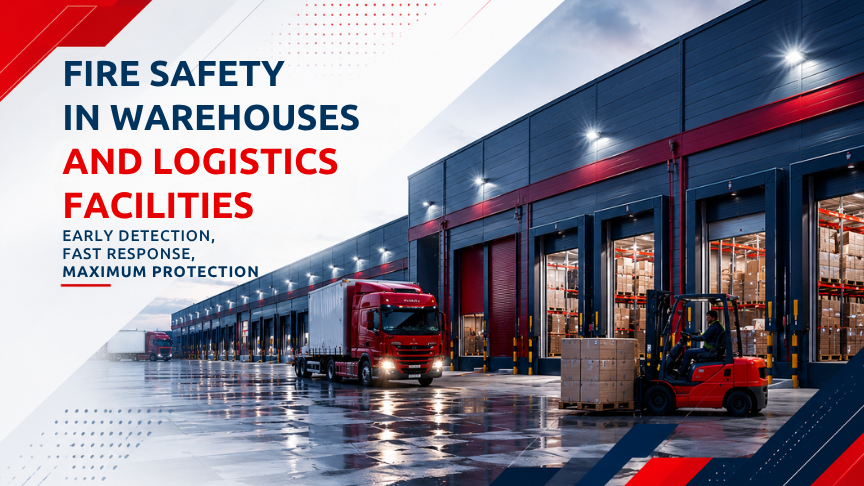
Warehouses and logistics facilities play a critical role in modern supply chains. With the rapid growth of e-commerce and industrial production, today's warehouses store larger inventories and operate around the clock. While this improves operational efficiency, it also increases fire risks that can threaten people, property, and business continuity.
A fire in a warehouse can spread rapidly because of high storage density, combustible packaging materials, and extensive racking systems. Beyond direct property damage, warehouse fires may interrupt production, delay deliveries, damage customer trust, and create significant financial losses.
For these reasons, fire safety should be considered an essential part of warehouse design rather than an afterthought. A modern fire protection strategy combines early fire detection, reliable alarm notification, emergency evacuation, and regular maintenance to minimize risks.
Warehouses differ significantly from office buildings or commercial facilities.
Large open spaces, high ceilings, densely packed storage racks, and continuous equipment operation create unique fire protection challenges.
Common fire hazards include:
Because smoke often develops inside storage racks before reaching the ceiling, traditional detection methods alone may not always provide the earliest possible warning.
Proper system design is therefore essential.
One of the most common design mistakes is relying only on ceiling-mounted smoke detectors.
In high-bay warehouses, smoke generated deep inside storage racks may remain trapped for a considerable period before reaching ceiling detectors.
Rack smoke detection places detectors closer to potential fire sources, allowing much earlier fire identification.
Earlier detection provides valuable additional response time, helping reduce fire spread and property damage.
For warehouses with tall storage systems, rack detection has become an increasingly important part of modern fire protection strategies.
Conventional point smoke detectors become less effective as ceiling heights increase.
Beam smoke detectors are specifically designed to monitor long distances across large open areas.
They provide several important advantages:
Beam detectors are widely used in logistics centers, manufacturing facilities, distribution hubs, aircraft hangars, and large industrial buildings.
Large warehouses require precise information during an emergency.
Addressable fire alarm systems identify the exact detector or device that triggered the alarm.
Instead of indicating only a detection zone, the control panel immediately identifies the specific detector location, allowing security teams to respond much faster.
Maintenance also becomes significantly easier because faults can be located quickly without inspecting large sections of the building.
For facilities covering thousands of square meters, addressable systems provide substantial operational advantages.
Early detection alone is not enough.
Occupants must also be alerted immediately.
Sounders provide audible alarms throughout the building, while visual alarm devices ensure that alarms remain noticeable even in noisy warehouse environments.
Emergency lighting and exit guidance systems continue operating during power failures, allowing employees and visitors to locate escape routes safely.
Integrating detection, notification, and evacuation systems creates a coordinated life safety solution that significantly improves emergency response.
Some warehouse environments require more than fire detection.
Battery charging rooms, generator rooms, chemical storage areas, and technical spaces may present gas hazards in addition to fire risks.
Gas detection systems integrated with the fire alarm control panel allow facility managers to monitor multiple safety risks through a single platform.
Integrated safety solutions simplify monitoring while improving overall facility protection.
Even the most advanced fire detection system requires regular maintenance.
Warehouses often contain dust, airborne particles, and changing environmental conditions that can affect detector performance.
Routine maintenance should include:
Preventive maintenance reduces false alarms while ensuring reliable operation during real emergencies.
Finder develops fire detection technologies suitable for warehouses, logistics centers, and industrial facilities.
Its product portfolio includes:
Together, these solutions provide early fire detection, reliable alarm notification, safe evacuation, and simplified maintenance for warehouse environments.
Warehouse fire safety is about much more than regulatory compliance.
A properly engineered fire protection system protects employees, inventory, infrastructure, and business continuity.
By combining rack smoke detection, beam smoke detectors, addressable fire alarm systems, emergency notification devices, and preventive maintenance, warehouses can significantly reduce fire risks and improve emergency response.
Investing in modern fire detection technology is one of the most effective ways to protect both people and valuable assets in today's logistics facilities.
Why are warehouses at higher risk of fire?
Warehouses contain high storage racks, combustible packaging materials, electrical equipment, and densely stored goods, all of which increase the potential for rapid fire spread.
Why is rack smoke detection important?
Fires often begin inside storage racks. Rack smoke detection identifies smoke before it reaches ceiling level, allowing earlier intervention and reducing fire damage.
Where are beam smoke detectors typically used?
Beam smoke detectors are ideal for warehouses, logistics centers, manufacturing plants, aircraft hangars, and other buildings with high ceilings and large open spaces.
Why are addressable fire alarm systems recommended for warehouses?
Addressable systems identify the exact detector that triggered the alarm, enabling maintenance personnel and emergency responders to locate the incident quickly.
Why should sounders and visual alarm devices be installed together?
Sounders provide audible warnings while visual alarm devices offer flashing light notifications. Together they improve occupant awareness, especially in noisy environments or for people with hearing impairments.
Are gas detection systems necessary in warehouses?
Gas detection systems are recommended for battery charging rooms, generator rooms, technical areas, and locations where hazardous gases may accumulate.
Why is regular fire alarm maintenance important?
Routine maintenance verifies detector performance, alarm panels, batteries, communication loops, and notification devices, ensuring reliable operation during an emergency.
What warehouse fire safety solutions does Finder provide?
Finder offers addressable fire alarm systems, wireless fire alarm systems, beam smoke detectors, optical smoke detectors, EN54-certified sounders and visual alarm devices, gas detection systems, and emergency guidance solutions.
 TR
TR