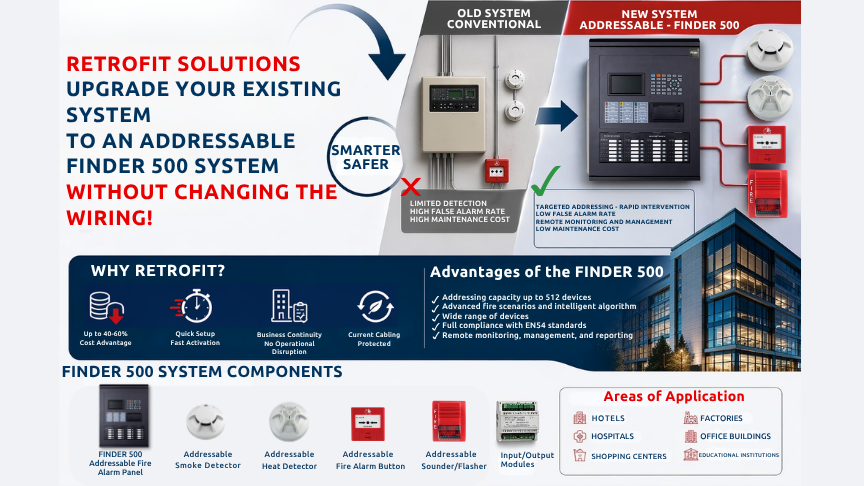
When businesses consider upgrading their fire alarm systems, they often ask:
“Do we need to replace the entire system and cabling?”
The answer is: No.
With modern retrofit solutions, it is possible to upgrade your system while keeping the existing infrastructure.
Retrofit means upgrading an existing system without completely replacing its infrastructure.
In fire alarm systems, retrofit:
It is especially common when upgrading from conventional to addressable systems.
Fire alarm systems are usually built with durable cabling infrastructure.
Therefore:
This approach:
- saves time
- reduces cost
- avoids operational downtime
Retrofit is recommended when:
In such cases, retrofit is more efficient than full replacement.
During retrofit:
-control panels are replaced
-detectors are upgraded
-software is modernized
cabling is usually retained
The system becomes equivalent to a new installation.
Up to 40–60% lower cost than full replacement.
The biggest transformation in retrofit projects is:
conventional --- addressable systems
Benefits:
Outdated systems:
The biggest risk:
system failure during an actual fire
Finder offers advanced retrofit solutions.
With Finder:
Key solutions:
Finder retrofit = maximum safety with minimum cost
Key steps:
Poor planning leads to hidden costs.
Conclusion: Upgrade Smart, Not Hard
Fire safety is not about replacing everything:
-full replacement is not always necessary
-smart retrofit is the right approach
-lower cost
-faster upgrade
-higher safety
What is fire alarm retrofit?
It is upgrading an existing system while preserving cabling infrastructure.
Can systems be upgraded without replacing cables?
Yes, in most retrofit projects existing cabling is reused.
Does retrofit reduce costs?
Yes, it provides significant cost savings compared to new installations.
How long does retrofit take?
From a few days to several weeks depending on project size.
Is upgrading to addressable systems mandatory?
Not mandatory, but highly recommended for modern buildings.
 TR
TR