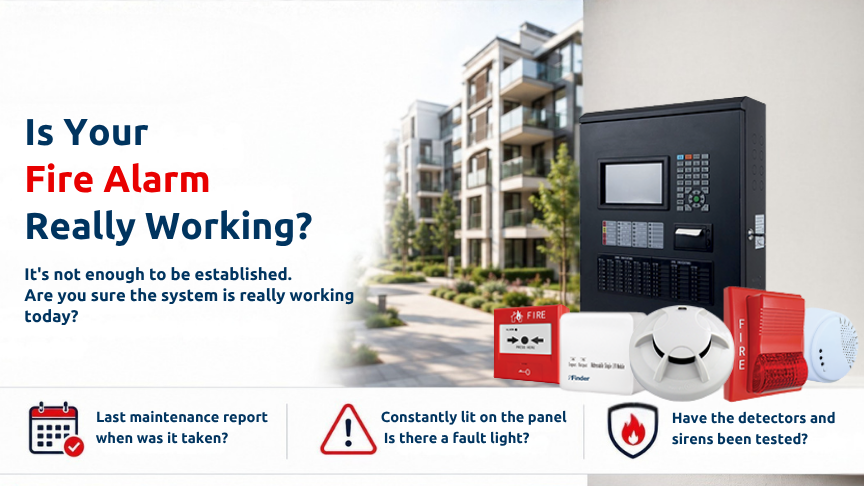
Having a fire alarm control panel installed in a building does not necessarily mean the building is ready for a fire emergency.
A fault that has remained on the panel for months, a disabled detector, an untested manual call point or deteriorated standby batteries may all compromise the performance of the system when it is actually needed.
For property and residential complex managers, therefore, the key question is not simply:
“Do we have a fire alarm system?”
It is:
“Is our fire alarm system fully operational today?”
Türkiye's Regulation on the Protection of Buildings from Fire requires fire detection and alarm systems to be designed and installed appropriately and kept in operating condition. Periodic inspection, testing and maintenance of systems and devices are also part of the responsibilities assigned to the building owner or manager.
An important amendment was published in Türkiye's Official Gazette No. 32943 on 1 July 2025 under Presidential Decision No. 10026.
Temporary Article 4 was added to the Regulation on the Protection of Buildings from Fire.
It required deficiencies in existing buildings covered by the Regulation where the procurement of materials required a process to be remedied by the building owner, manager or head of the relevant institution by 31 December 2025.
After that deadline, the competent licensing authorities were assigned responsibility for checking whether the deficiencies had been remedied.
This provision should not, however, be interpreted as a new universal equipment list that applies identically to every apartment building.
The applicable fire safety requirements still depend on factors such as building use, height, size, occupancy and specific risk areas.
A separate regulation published on 10 January 2026 is sometimes confused with the requirements for residential buildings.
That regulation concerned certain accommodation establishments requiring a fire department report under Türkiye's workplace licensing legislation.
It introduced a specific process extending to 31 May 2026 for those establishments. It was not a general extension granted to residential apartment buildings or housing complexes.
For residential property managers, postponing fire safety assessments on the assumption that every building received the same extension would therefore be misleading.
Another significant legal development took place in May 2026.
Law No. 7579, published on 22 May 2026, amended Türkiye's Zoning Law and introduced a framework for periodic fire safety inspections and fire safety reports.
Under the amendment, buildings holding documents permitting their use may undergo periodic fire safety inspections following an application by the building owner within the prescribed period.
The inspections may be performed by the relevant municipal fire service or, under the conditions established by law, authorised fire safety specialists, with a fire safety report issued following the inspection.
Where deficiencies are identified during a periodic inspection, they must be remedied within the period granted by the relevant authority, which may not exceed six months, and a valid fire safety report must then be obtained.
The law also provides that details including which buildings will be subject to inspection, inspection periods and the qualifications and responsibilities of fire safety specialists will be determined through regulations issued by the Ministry.
This represents an important shift in approach:
Fire safety is increasingly being treated as a building-lifecycle responsibility rather than a one-time approval issue.
Fire alarm systems remain continuously operational for years, often without ever being activated by a real fire.
During that period:
Many of these issues only become visible when the system is properly tested.
A persistent FAULT indicator on the control panel should therefore never become part of the building's accepted “normal condition.”
A fault indication requires investigation.
TS CEN/TS 54-14 is one of the key technical references covering the planning, design, installation, commissioning, use and maintenance of fire detection and fire alarm systems.
A maintenance programme should typically address the following areas.
The panel should be checked for active faults, disabled devices, communication problems and abnormal system conditions.
A detector being physically present on the ceiling is not sufficient. Its ability to detect an appropriate test stimulus and communicate the alarm to the control panel should be verified.
Call points should be checked for both physical condition and correct alarm transmission.
Audible and visual alarm devices should be tested to confirm correct operation.
The system must be capable of continuing its safety function during a mains power failure, making battery and power-supply checks particularly important.
Inspections, tests, detected faults, repairs and system modifications should be documented and retained.
Maintenance programmes should be established with reference to TS CEN/TS 54-14, manufacturer requirements, the design of the installed system and the risks of the individual building.
EN 54 is a family of European standards covering individual components of fire detection and fire alarm systems.
Different parts of the EN 54 series address equipment including:
For this reason, simply purchasing a product marketed as a “fire detector” is not sufficient.
The applicable product standard and supporting certification documentation should be checked during system design and procurement.
Finder also addresses its fire detection solutions within the EN 54 and TS CEN/TS 54-14 framework in its technical fire safety content.
A fire alarm system that fails to activate is clearly dangerous.
But a system that constantly produces unwanted alarms also deserves attention.
False or unwanted alarms may be associated with factors such as:
Repeated false alarms can also lead to alarm fatigue, causing occupants to underestimate or ignore a real evacuation warning.
Property managers should therefore monitor not only whether the system works, but also how many false alarms have occurred and why.
If several of these questions cannot be answered clearly, the actual condition of the system should be professionally assessed.
Effective fire safety does not end when a system is installed.
It depends on appropriate system design, compliant equipment, continuous supervision, functional testing, periodic maintenance and proper documentation.
Finder provides fire detection and alarm solutions for different building requirements while also offering inspection and maintenance services for existing fire alarm systems. Its current maintenance services are not limited solely to Finder-branded installations and can also cover systems from other manufacturers.
If a fault light has been glowing on your fire alarm panel for months, do not treat it as normal.
A fire alarm system should be tested before the day it is needed.
Are fire alarm systems mandatory in every apartment building in Türkiye?
The requirement depends on factors including building classification, height, occupancy, size and specific risk areas. The Regulation on the Protection of Buildings from Fire must be evaluated for the individual building.
Is a yellow fault indicator on a fire alarm panel normal?
No. A fault indication means that a condition requiring technical investigation has been detected.
Who is responsible for fire alarm system maintenance?
Under the Regulation, periodic inspection, testing and maintenance are to be arranged by the building owner or manager, or an authorised person to whom this responsibility has formally been assigned.
What was the significance of 31 December 2025?
It was the deadline established by the July 2025 amendment for addressing deficiencies in existing buildings covered by the Regulation where material procurement required additional time.
Did the 31 May 2026 deadline apply to all residential complexes?
No. The January 2026 provision concerned certain accommodation establishments requiring fire department reports.
Was a new fire safety inspection framework introduced in 2026?
Yes. Law No. 7579 introduced provisions covering periodic fire safety inspections and fire safety reports within Türkiye's Zoning Law.
Note: Exact legal and technical requirements vary according to building classification, physical characteristics and the competent authority. Building-specific assessment is therefore essential.
 TR
TR