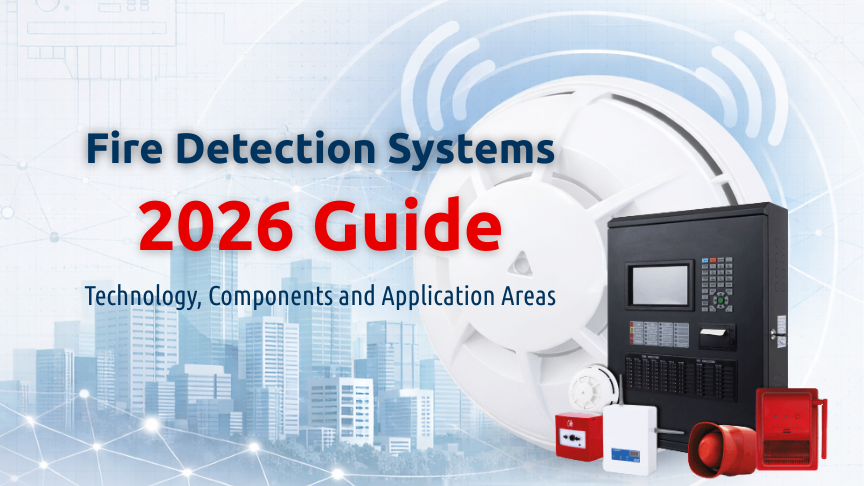
Fire safety is one of the most critical security priorities in modern buildings. Especially in facilities with high human traffic such as commercial buildings, industrial plants, hospitals, and large-scale projects, fire detection systems are not only safety equipment but also comprehensive risk management solutions.
Fire detection systems are technological solutions designed to detect fire risks at the earliest possible stage, alert occupants, and initiate emergency response procedures. These systems help ensure that fires are detected before they spread, allowing faster evacuation and quicker intervention.
Today, fire detection technologies have evolved beyond simple alarm systems. Modern solutions integrate smart sensors, advanced detection algorithms, and building management systems (BMS) to create intelligent fire safety infrastructures.
The first minutes of a fire are critical for effective response. Fire detection systems activate during these early stages and help prevent the situation from escalating.
The main objectives of fire detection systems include:
These systems significantly reduce potential loss of life and property, especially in large and complex buildings.
A fire detection system consists of multiple components working together as an integrated network to continuously monitor fire risks.
The main components of fire detection systems include:
These components constantly monitor the environment and trigger the alarm system when any risk is detected.
One of the most critical elements of fire detection systems is fire detectors. Detectors identify physical changes in the environment and activate the system.
The most commonly used detector types include:
Smoke detectors identify smoke particles generated during the early stages of a fire. For this reason, they are widely used in most fire safety projects.
Heat detectors respond to rapid increases in temperature. They are particularly suitable for environments such as kitchens, industrial facilities, and dusty areas.
Modern fire detection systems often use multi-sensor detectors that analyze both smoke and temperature changes, providing more accurate fire detection and reducing false alarms.
The fire alarm control panel acts as the central brain of the system, processing signals received from detectors and managing alarm scenarios.
The key functions of the panel include:
In addressable systems, the panel can display the exact location of the fire, enabling faster intervention.
Fire detection systems are generally designed using two different architectures.
Conventional systems are commonly used in smaller facilities. In these systems, fire detection is zone-based.
They are typically installed in:
small offices
retail shops
small commercial buildings
When a fire is detected, the system triggers an alarm but does not identify the exact location of the fire.
Addressable systems offer more advanced functionality. Each detector is assigned a unique address, allowing the control panel to identify the exact location of the fire.
These systems are commonly used in:
Addressable systems provide faster response times and lower false alarm rates.
By 2026, fire detection technologies have become significantly more intelligent. Modern fire detection systems now include features such as:
These advancements transform fire detection systems from simple alarm devices into essential components of smart building security infrastructure.
Using certified fire detection equipment is essential for system reliability and safety compliance.
The most widely recognized fire safety certifications include:
These certifications confirm that fire detection products have successfully passed strict performance and safety tests.
Certified systems ensure reliable operation during real fire emergencies.
What is a fire detection system?
A fire detection system is a safety system designed to detect fire at an early stage, trigger alarms, and initiate evacuation procedures.
How does a fire alarm system work?
Fire alarm systems operate using detectors that identify smoke or temperature increases and send signals to the fire alarm control panel.
What is an addressable fire alarm system?
In addressable systems, each detector has a unique address, allowing the control panel to pinpoint the exact location of the fire.
fire detection systems, fire alarm system, how fire detection systems work, addressable fire alarm system, fire safety systems, fire detection system, how fire alarm systems work, fire detector working principle, fire alarm system components, addressable fire alarm system explained, fire safety technology, advantages of fire detection systems
 TR
TR