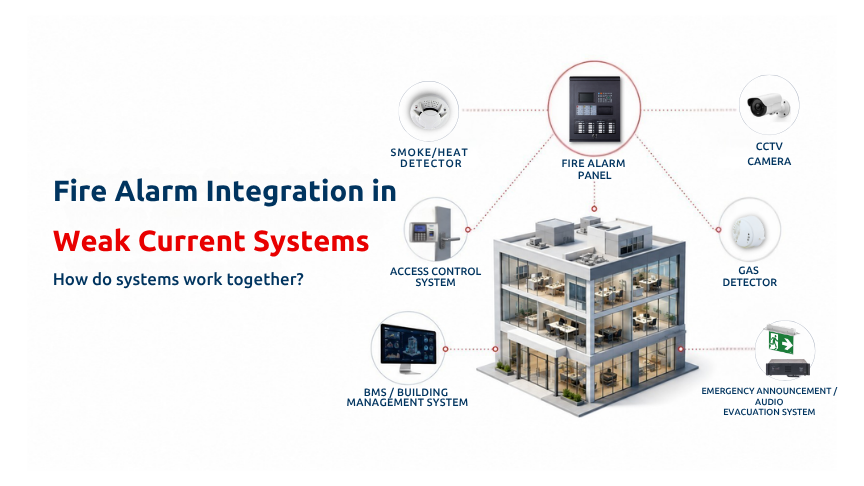
Modern fire alarm systems rarely operate in complete isolation.
Hotels, hospitals, shopping malls, industrial facilities, campuses, warehouses, and high-rise buildings typically contain multiple low-voltage and building automation systems. Fire detection, access control, voice evacuation, gas detection, building management, remote monitoring, and other systems may need to coordinate during an emergency.
Fire alarm integration, however, is not simply about connecting every system to a common software platform.
The objective is to ensure that each system performs the correct action when a predefined fire or emergency condition occurs.
For example, when an addressable smoke detector enters alarm condition, the fire alarm control panel may activate notification devices and, depending on the approved fire strategy, provide control information to access control, smoke management, voice evacuation, or central monitoring systems.
Effective integration therefore transforms separate building technologies into a coordinated life-safety architecture.
The term low-voltage systems generally refers to electronic technologies used for communication, security, monitoring, and building control.
Fire detection and alarm systems, access control, CCTV, voice evacuation, intercom, gas detection, building management, and remote monitoring can all form part of this infrastructure.
Finder's system portfolio includes fire alarm, gas alarm, emergency lighting and guidance, access control, emergency voice evacuation, and remote monitoring solutions.
Having these systems in the same building does not automatically mean that they should all communicate with each other.
Integration must be engineered according to the building's fire strategy, operational requirements, and approved cause-and-effect matrix.
During a fire emergency, time is critical.
If building systems are completely independent, technical or security personnel may need to perform several actions manually.
An integrated architecture allows predefined responses to be initiated automatically.
Once a fire condition is identified, alarm notification can begin while control signals are provided to other systems included in the fire strategy.
The most important principle is maintaining the independence and reliability of the fire alarm system.
Failure of a BMS, CCTV platform, or another building system should not prevent the fire alarm system from detecting fire and performing its primary alarm functions.
Integration should enhance the emergency response rather than create unnecessary dependency.
The cause-and-effect matrix defines what should happen after a particular fire alarm event occurs.
A cause could be activation of a smoke detector, heat detector, manual call point, or another monitored device.
The resulting effects might include alarm notification, releasing selected access-controlled doors, initiating voice evacuation messages, providing signals to smoke management systems, or displaying the event at a central monitoring location.
The exact sequence varies significantly between buildings.
A hospital may require a phased response, while a warehouse, hotel, shopping mall, or industrial process facility may use a completely different evacuation and control strategy.
For this reason, the cause-and-effect matrix should be developed as part of the project's fire engineering process rather than created after installation.
A Building Management System provides centralized monitoring and control for various building services.
Fire alarm information such as alarm, fault, or selected status conditions may be transferred to the BMS so that technical personnel can see relevant events on a central interface.
However, the BMS should not be treated as a replacement for the certified fire alarm control panel.
The fire alarm system must continue to perform its primary life-safety functions independently.
Depending on project requirements, integration may use relay contacts, addressable I/O modules, or other approved engineering interfaces.
The method should be selected according to system architecture, monitoring requirements, and the approved project strategy.
Access-controlled doors improve everyday building security but must be considered carefully during emergency evacuation.
In some projects, confirmed fire conditions may require selected electronically controlled doors to release so occupants can follow designated escape routes.
This does not mean that every controlled door should automatically unlock whenever any detector activates.
High-security facilities, compartmented buildings, healthcare environments, and other specialized projects may require more complex sequences.
The relationship between access control and fire alarm systems should therefore be defined according to the evacuation strategy and individual door function.
In large or complex buildings, alarm sounders alone may not provide enough information to occupants.
Voice evacuation systems can provide clear spoken instructions that help manage evacuation in a more controlled manner.
Fire alarm information can be used to initiate predefined messages in selected evacuation zones.
This is particularly useful in shopping malls, hotels, transport facilities, campuses, and large public buildings where phased or zoned evacuation may be required.
Instead of relying only on an alarm tone, occupants receive instructions appropriate to the emergency scenario.
Fire may not be the only safety risk in a facility.
Parking garages, technical rooms, boiler areas, industrial plants, and other environments may also require gas detection.
Gas alarms can form part of a wider safety strategy in which gas concentration information triggers predefined actions such as ventilation control, alarm notification, or central monitoring.
Finder's portfolio includes gas and water leakage alarm systems alongside its fire alarm solutions.
Integrating different hazard monitoring systems can improve situational awareness while allowing each safety system to retain its appropriate function.
Input/output modules are key components in many fire alarm integration projects.
An input can monitor a signal or status from external equipment, while an output can provide a control signal from the fire alarm system to another device.
The Finder 500 Series includes the FF MIC500 addressable I/O module for external device control and input monitoring. The FF LI500 loop isolator is designed to isolate problematic sections of the addressable loop and support system reliability.
This modular architecture allows fire alarm systems to participate in complex building cause-and-effect scenarios without treating every external device as a fire detector.
CCTV can support situational awareness during an emergency.
For example, a fire alarm event may help an operator quickly select camera views associated with the alarm location through an appropriate security management platform.
This can assist investigation and emergency response.
However, video surveillance and certified fire detection perform different functions.
Camera images should not automatically be considered a substitute for fire detectors unless a dedicated certified detection technology has been designed for that purpose.
Integration should therefore focus on improving operator awareness rather than replacing the fire alarm system.
Extending fire detection in an existing building can be challenging.
New cabling may disrupt hospital operations, hotel occupancy, active commercial facilities, or architecturally sensitive buildings.
Finder's 200/500 Series Wireless Fire Alarm System provides wireless addressable smoke and heat detection, manual call points, and alarm notification devices for projects where conventional cabling is difficult.
In appropriately engineered hybrid projects, wired and wireless fire alarm devices can be considered within the wider building fire strategy.
Wireless technology does not remove the need for professional design, coverage assessment, testing, and maintenance.
One of the most serious mistakes is making the fire alarm system unnecessarily dependent on another building automation platform.
Another common problem is an incomplete cause-and-effect matrix.
Instructions such as "unlock the doors when there is a fire" are not detailed enough for complex projects. Designers must define which doors respond to which alarms, whether confirmation is required, and what happens if another system is unavailable.
Testing also needs to go beyond individual components.
A detector test should verify not only that the fire panel receives the alarm, but also that every associated function defined by the approved cause-and-effect matrix responds correctly.
Integrated scenario testing is therefore essential during commissioning and periodic maintenance.
The Finder 500 Series Addressable Fire Alarm System includes addressable fire alarm control panels, optical smoke detectors, heat detectors, combined smoke and heat detectors, manual call points, sounder-beacons, loop isolators, and I/O modules.
Finder's wider portfolio also includes gas detection, access control, emergency lighting and guidance, emergency voice evacuation, and remote monitoring technologies.
These systems provide building designers with components that can support coordinated safety strategies according to the requirements of each project.
Fire alarm integration with low-voltage systems is not simply a connectivity exercise.
A successful architecture detects fire at the correct location, communicates the event reliably, and coordinates predefined responses across relevant building systems.
Addressable fire alarm systems, I/O modules, BMS, access control, voice evacuation, gas detection, CCTV, and remote monitoring can all contribute to a more coordinated emergency response when they are engineered around a clear cause-and-effect strategy.
The key principle is that integration should strengthen rather than compromise the independence and reliability of the fire alarm system.
Technical note: Final integration architecture and cause-and-effect programming should be designed, tested, and documented by qualified professionals according to applicable regulations, standards, manufacturer requirements, building use, and the approved fire strategy.
What is fire alarm system integration?
Fire alarm integration allows the fire detection system to exchange information with systems such as BMS, access control, voice evacuation, gas detection, and other building technologies according to predefined emergency scenarios.
Can a fire alarm system be connected to a BMS?
Yes. Alarm, fault, and selected status information may be transferred to a BMS. The fire alarm system's primary life-safety functions should remain independent.
Can access-controlled doors unlock during a fire alarm?
Selected doors may be released according to the approved evacuation strategy. The exact response should be defined in the cause-and-effect matrix.
What does a fire alarm I/O module do?
An I/O module allows the fire alarm system to monitor external signals and provide control outputs to other equipment.
Can CCTV be integrated with a fire alarm system?
Yes. Fire alarm events can support automatic camera selection or operator awareness through appropriate integration, but CCTV does not replace certified fire detection.
Can a voice evacuation system be activated by the fire alarm system?
Depending on project design, fire alarm events can initiate predefined emergency messages in selected voice evacuation zones.
Can gas detection be integrated with other building systems?
Yes. Gas alarms may be linked to ventilation, alarm notification, or central monitoring functions according to the project's safety strategy.
What integration solutions does Finder provide?
Finder provides addressable fire alarm systems, I/O modules, detection and notification devices, gas detection, access control, emergency voice evacuation, and remote monitoring solutions.
 TR
TR