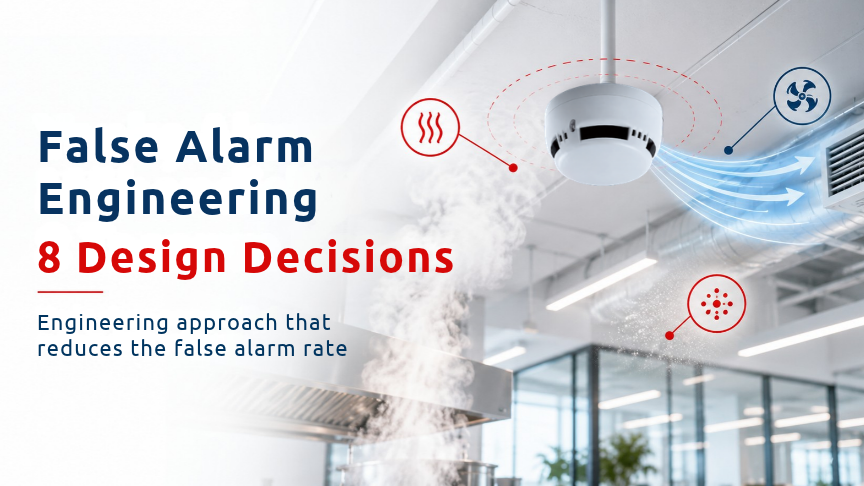
In fire detection systems, a false alarm is not simply a defective-detector problem. Mismatched sensing technology, poor placement, weak zoning, uncontrolled alarm verification logic, contamination, building or process changes and incomplete event data can all contribute to unwanted alarms.
A sustainable solution requires classifying the cause, confirming the root cause and making the design–operation–maintenance cycle measurable. The objective is not a system that “never alarms,” but one that detects real fire in time while systematically reducing non-fire activations.
Repeated false alarms do more than increase technical service workload. They can interrupt operations, reduce user confidence and affect how people respond to a real alarm.
|
Impact |
Operational consequence |
|
Alarm fatigue |
Response to a real alarm may become slower |
|
Operational disruption |
Evacuation, production or service may stop unnecessarily |
|
Team mobilisation |
Time and resources may be wasted |
|
Loss of confidence |
Users may be tempted to isolate or bypass the system |
|
Maintenance cost |
Service call-outs may continue without root-cause correction |
False-alarm performance should therefore be evaluated across the whole system, not only at individual detector level.
A single total alarm count is not sufficient. Each event should be recorded with its device, location, time, operating condition and verified cause.
The record should include date and time, panel/loop/address, room or area, environmental conditions, system status, root-cause category, corrective action and whether the event recurred.
One detector repeatedly alarming during cleaning is a different problem from several devices alarming randomly. Events should therefore be reviewed by device and by location.
Useful indicators can include false alarms per 100 devices, recurrence by room and device type, the share generated by the most frequent addresses, events with no identified cause and 30/90-day recurrence checks after corrective action.
An “alarm” entry in panel history is not a root cause. Room conditions, device condition and user activity should be verified before the event is closed.
The choice between smoke, heat, flame or multi-criteria detection should not be based only on the expected fire type. Aerosols, dust, steam, exhaust, temperature and humidity present during normal operation should also influence selection.
Steam and aerosols may affect kitchens or shower areas; workshops may contain dust, fumes or welding activity; car parks may be exposed to exhaust and temperature changes; cold spaces may experience condensation or icing.
High ceilings may require assessment of dilution and stratification, while clean critical areas may require very early warning.
Randomly reducing sensitivity or disabling a detector should be avoided. It may hide an unwanted alarm while delaying response to a real fire.
Even the correct detector type can produce recurring unwanted alarms when installed in the wrong location.
Supply-air throw, extract airflow, door drafts, kitchen steam, showers, loading doors and process outlets can alter conditions around a detector.
Site review should check whether supply air blows directly into the device, whether extract airflow pulls contaminants across it and whether steam or dust reaches the detection zone during normal activity.
Ceiling obstructions and maintenance access should also be reviewed. The detector should remain in the same effective volume as the expected smoke accumulation and remain accessible for testing and cleaning.
Correct zoning does not physically prevent a false alarm, but it helps teams locate the event, verify the cause and manage recurring addresses.
Zone boundaries should correspond clearly with floors, fire compartments and operational responsibility. Address text should identify building, floor, room and device clearly enough to indicate one unique location.
The panel address and the current drawing or graphic should refer to the same point. Isolation, reset and test functions should be controlled and logged.
When a device is moved, its physical position, panel text, drawing and asset record should all be updated together.
Time verification, two-device conditions or multi-criteria algorithms may help reduce unwanted alarms in some applications.
They must not create an unjustified delay to life safety, evacuation, alarm notification or fire-control functions.
Multi-criteria detection can evaluate more than one fire signature. Two-device or zone conditions may limit some automatic outputs from a single event. A short verification period may allow trained staff to investigate, while day/night modes may support different operating strategies.
Unattended periods, mode-change failures and inappropriate alarm delays should be evaluated. Every verification scenario should be documented in the cause-and-effect matrix and tested on site.
Verification or delay should be used only where current requirements, the fire-risk assessment, authorised design and approved product functions permit it.
Contamination should be treated as a predictable lifecycle load rather than an unexpected post-installation problem.
In dusty, oily or humid environments, detector selection, maintenance interval and access should be considered together during design.
Repeated alarms from the same device may indicate local aerosol or contamination. An increase across one area may point to process or HVAC changes. Seasonal events may be related to humidity, condensation or temperature.
Alarms after maintenance may indicate incorrect reassembly, residue or test effects. Gradual sensitivity change may be linked to optical-chamber contamination and should be assessed using the manufacturer's method.
Repeated cleaning alone is not root-cause control; the reason for the exposure should also be investigated.
Testing and maintenance should not create unnecessary alarms or leave the system uncontrolled or disabled.
Relevant parties should be informed before testing, and alarm transmission and connected outputs should be managed in a controlled manner.
Temporary isolations should be logged with device or zone, start/end time and responsible person. Dusty refurbishment work should follow a temporary protection and operating plan, and all temporary covers and isolations should be removed when work is complete.
Cleaning chemicals, smoke machines, hot work and aerosol use should be included in the fire alarm procedure. At close-out, normal panel condition, reinstated outputs and sample functional tests should be confirmed.
Leaving a detector cover or temporary isolation in place at the end of a shift is a critical error. Temporary controls should be time-limited, visible and assigned.
A fire detection design should not be assumed to remain valid when room use changes.
New kitchen equipment, racking, doors, partitions, diffusers, processes or shift patterns can change the false-alarm profile.
Changes in room use should trigger review of fire type, normal aerosols and detector technology. HVAC changes should trigger review of smoke and contaminant movement. Ceiling or partition changes may affect coverage, zoning and address text.
Process changes may alter dust, steam, temperature and operating hours. Software or cause-and-effect changes may affect alarm, delay, transmission and control outputs.
Device substitution should include compatibility, approval, base, protocol and configuration checks. Change management should cover operational changes as well as major technical alterations.
“Reset and returned to normal” is not, by itself, a solution.
For recurring false alarms, event evidence should be preserved, the cause classified, the alarm mechanism assessed and an appropriate corrective action applied.
Panel history, photographs or user information should be retained. The event can then be classified as environment, device, placement, people, process or unknown.
After correction, a functional test should be performed and recurrence monitored over an appropriate period. Similar rooms and devices should also be reviewed proactively.
The device with the highest alarm frequency should not automatically be replaced first. The device, base, room, airflow, process and event timing should be examined together.
|
Period |
Focus |
Deliverable |
|
First 15 days |
Data cleanup and most frequent repeat addresses |
Baseline, event classes and owners |
|
Days 16–30 |
Site review and quick corrections |
Placement, cleaning, text and procedure actions |
|
Days 31–60 |
Design and configuration changes |
Approved revision and test records |
|
Days 61–90 |
Effectiveness verification |
Before/after rate, open risks and revised maintenance plan |
Success should not be measured only by the total number of false alarms. Recurring addresses, events with no identified cause and temporary isolation time should also decrease while functional testing remains complete.
Is a false alarm the same as a fault?
No. A false alarm is a fire alarm generated when there is no fire. A fault reports a device, circuit, power-supply or communication problem.
Will lowering detector sensitivity solve false alarms?
Not safely by itself. The root cause, environment, detector technology, placement and permitted product settings should be evaluated together.
Can steam activate a smoke detector?
Under some optical sensing conditions, steam or aerosol can cause an unwanted response. Placement and technology should be selected according to the actual use of the room.
Can alarm verification be used in every building?
No. The life-safety strategy, applicable requirements, project standard, building use and approved system functions must permit it.
Do multi-criteria detectors eliminate false alarms completely?
No. They may improve resistance to unwanted alarms, but they cannot compensate for poor placement, heavy contamination or incorrect configuration.
Should the device with the most alarms be replaced immediately?
The device, base, room, airflow and event timing should be inspected first. If replacement is required, compatibility and configuration should be verified.
How should false alarm rates be compared?
The monitoring period, device population, room types and operating hours should be stated, and normalised indicators should be reviewed together with root-cause distribution.
Can detectors be disabled during refurbishment?
Only through an authorised, time-limited and recorded impairment process with compensating safety measures and reinstatement checks at completion.
False-alarm performance cannot be improved simply by replacing devices. Event evidence and the building's real operating conditions should be fed back into the design.
Detector–environment matching, correct placement, clear zoning, controlled alarm verification, contamination management, maintenance procedures, change management and root-cause analysis should be managed together.
Finder's technical team addresses event analysis, product–environment matching, project revision, commissioning and lifecycle maintenance as an integrated approach.
• CEN/CENELEC ve TSE — projede geçerli güncel EN 54 ürün standartları ile CEN/TS 54-14 tasarım/uygulama rehberi.
• Fire Industry Association (FIA) — false alarm reduction resources: https://www.fia.uk.com/
• NFPA LiNK — sözleşmesel olarak uygulanıyorsa güncel NFPA 72: https://link.nfpa.org/
 TR
TR