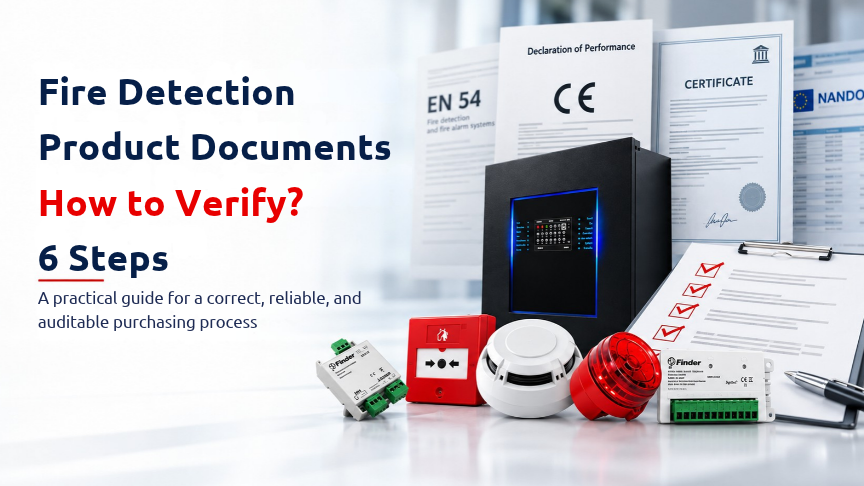
Document verification for fire detection products is not simply a check for whether a PDF exists. A reliable verification process creates an uninterrupted evidence chain from the exact model code on the physical product to the technical specification, Declaration of Performance (DoP), CE marking information, third-party certificate, notified-body scope and system compatibility.
A file name, logo, stamp or the existence of a PDF is not sufficient evidence by itself. The document content, annexes, scope, revision and verification source should be reviewed together. If the model or scope does not match at any of the six stages, the product should not be classified as properly documented until clarification and current evidence are obtained.
|
Step |
Check |
Expected output |
|
1 |
Product and manufacturer identity |
Verified model and production-site record |
|
2 |
Correct standard and intended use |
Product-to-standard mapping |
|
3 |
DoP and CE marking information |
Consistent declared performance |
|
4 |
Certificate and notified body |
Verified third-party scope |
|
5 |
Datasheet and system compatibility |
Project-suitable and interoperable solution |
|
6 |
Validity, traceability and filing |
Auditable procurement file |
The check should be performed separately for every product model. Review the document content rather than the file name, and treat uncertainties as open actions rather than automatically classifying them as acceptable.
Verification starts with the physical product. A commercial series name is not a substitute for the actual model listed in the certificate. The product label, packaging, quotation, DoP, certificate and datasheet should all connect to the same identity chain.
The brand and legal manufacturer should first be distinguished. The brand shown on the product and the legal manufacturer stated in the DoP or certificate may not necessarily represent the same concept. The exact model or type code should be recorded exactly as shown on the product label and body, including spaces, hyphens, suffixes and variants.
Serial or lot information should be retained for production traceability and potential recall processes. The production site should be checked against the certificate scope or annexes to confirm that the relevant facility is covered. A local importer or distributor label should not conceal or make the manufacturer identity unclear.
Photographs of the actual delivered product, including its label and connection surfaces, should also be retained. This creates a direct link between the physical product and the model identified in the documentation.
A general description such as “250 Series detector” does not prove certificate coverage. The exact offered product code, or a clearly defined covered variant, should appear in the certificate annex.
At the end of this stage, the exact model code should be recorded, a photograph of the actual product label should be available, the manufacturer in the DoP and certificate should link to the same legal entity, the production-site scope should be visible and the variant or accessory limitations in the annexes should have been reviewed.
The result may be classified in three ways: “acceptable” when identity information matches across all documents; “clarification required” when there is a wording or revision difference awaiting manufacturer confirmation; or “not acceptable” when the model or production site is outside the documented scope.
The function of the product determines which EN 54 part should be checked. A generic statement such as “EN 54 compliant” or “EN 54 certified” is therefore not sufficient.
For control and indicating equipment, EN 54-2 is the first reference; EN 54-4 applies to the power supply, and EN 54-13 may be considered for system compatibility where applicable. Point smoke detectors are associated with EN 54-7, point heat detectors with EN 54-5, manual call points with EN 54-11, sounders with EN 54-3, visual alarm devices with EN 54-23, short-circuit isolators with EN 54-17 and input/output modules with EN 54-18. For wireless components, EN 54-25 should be checked together with the relevant part covering the product’s primary function.
Identifying the correct standard part is not enough by itself. The edition stated in the datasheet should match the certificate, the certified intended use should correspond with the actual project use, transition dates between editions should be considered and national acceptance or marking requirements in the target market should also be reviewed.
The presence of a document in an official standards catalogue does not automatically mean that it is the applicable harmonised reference for a product on a particular date. The official source, target market and document date should therefore be considered together.
The Declaration of Performance is the primary regulatory record of the performance declared by the manufacturer. CE marking is not a certificate; it indicates that the manufacturer assumes the relevant regulatory responsibility.
The DoP review should cover the unique DoP number, product type or model, intended use, manufacturer, technical specification, AVCP system or relevant body, declared performance, signature and date. Each item should be matched against another source.
The model in the DoP should be identical to the product label and quotation. The intended use should correspond with the project specification. Manufacturer information should be consistent with the certificate and invoice, while the technical specification should correspond with the standard and edition shown in the certificate.
Body information should be checked against the certificate and NANDO record. Declared performance classes and values should be compared with the datasheet and project requirements.
The CE label should be checked for the CE symbol, the body identification number where applicable, manufacturer name or identifying mark, product type/lot/serial identification, marking year and DoP reference where applicable, the relevant technical specification, intended use and required performance references.
The presence of “NPD – No Performance Determined” in a DoP does not automatically mean non-compliance. However, the product should not be accepted until it has been established whether that characteristic is required by the project specification or target market.
If the datasheet claims a higher performance level while the DoP shows a different value or NPD, the DoP should be used for the regulatory declaration and a written manufacturer explanation should be requested.
A certificate PDF is meaningful only after the authority of the issuing body, the current status of the certificate and the exact scope covering the offered product have been verified.
The body name and identification number should be checked in the official record. The certificate number and document type should be confirmed through an official body or manufacturer verification channel. Manufacturer and production-site information should be compared across the certificate main page and annexes, and the exact offered product code should be found in the model schedule.
The standard and edition should be compared with the current official reference. The issue and revision history should be reviewed, and all limitations and notes should be read. Reviewing only the first page of a certificate is not sufficient.
Four elements are particularly important in a NANDO check: the identification number and legal name of the body, the relevant EU legislation scope, the product family or harmonised technical specification, and the conformity-assessment task the body is authorised to perform.
If the certificate is active and the scope matches, the verification date and source should be added to the file. If there is a revision difference, the current certificate should be requested. If the document is suspended or withdrawn, the product should not be accepted until an official explanation is obtained. If no record can be found, the document should be marked as unverified.
Logos, stamps and signatures may appear convincing. Verification against counterfeit or out-of-scope documentation therefore requires an official body record, an official manufacturer documentation channel and an exact scope match.
A valid product document does not mean that the product can be used in every project or with every control panel. Project suitability and system compatibility should be assessed separately.
Supply and current values should be compared with panel or loop capacity and alarm/standby loads. Protocol and firmware information should be verified against the panel compatibility list and supported versions. Isolator behaviour should be checked against the circuit topology and short-circuit scenario.
Environmental classification should be matched with temperature, humidity, IP level and indoor/outdoor conditions. The approved use of bases, enclosures, sockets and other accessories should be reviewed. Functional settings such as sensitivity, sounder tone, visual coverage or delay should correspond with the intended project use.
For input/output modules, cause-and-effect logic and fail-safe behaviour should be reviewed. Manufacturer procedures, test intervals and consumable or spare-part information should also be considered for maintenance and testing.
Priority evidence for system compatibility includes the manufacturer’s current compatibility list, product and panel installation/use manuals, certificate or EN 54-13 scope where applicable, project calculations and the approved cause-and-effect matrix, followed by commissioning and functional-test records.
Statements such as “it operates at the same voltage,” “we tested it on site” or “the connector fits” do not replace documented system compatibility.
For export documentation, additional checks should cover target-country language, labelling and document-access requirements, local representative or importer responsibilities, local marks or registration requirements in addition to CE, consistency between customs tariff/origin information and commercial documents, and current national conformity procedures for the target country.
Document verification does not end when the correct document has been found. The date and source of the verification should also be recorded. Web links, certificate status and document revisions can change, so an auditable archive should be maintained.
The file should contain the product-label photograph, current DoP, certificate with all annexes, NANDO or body-verification record, datasheet and manual, compatibility list, assessment form and change record. The source URL, access date, document revision and reviewer should be clearly recorded.
Older revisions should be archived rather than deleted, but they should be clearly identified as superseded or no longer current.
Documents should be rechecked when there is a new order or supplier, a model or hardware change, firmware change, standard-edition or harmonised-reference change, certificate revision, suspension or withdrawal, change of production site or legal manufacturer, field failure, recall or non-conformity notification.
|
Result |
Criterion |
Procurement action |
|
APPROVE |
All six steps are complete and consistent |
Proceed to technical/project approval |
|
CONDITIONAL |
A low-risk record is missing with a written action |
Hold under controlled follow-up until completed |
|
REJECT |
Critical model, standard, body or compatibility mismatch |
Stop purchase or acceptance |
A disciplined document-verification process reduces the risk of counterfeit or out-of-scope documentation, makes procurement more auditable and strengthens the distributor’s technical credibility with customers.
Where should document verification start?
Start with the physical product label and exact model code. The quotation, DoP, certificate, datasheet and other documents should all be matched to that identity.
Is the first certificate page sufficient?
No. Model schedules, production sites, limitations and variants are often contained in certificate annexes. All annexes and notes should be reviewed.
What does a NANDO check confirm?
A NANDO check helps verify the notified scope of the body for the relevant legislation, product family or technical specification and conformity-assessment task.
What if the DoP and datasheet differ?
For the regulatory performance declaration, the DoP should be used. If there is a difference, a written manufacturer explanation and current documentation should be requested.
Does CE marking prove compatibility between the panel and field devices?
No. CE marking does not by itself demonstrate system compatibility. Panel-device compatibility should be separately verified through manufacturer compatibility lists, applicable documentation, project calculations and functional testing.
When should documents be rechecked?
Documents should be rechecked for new orders, supplier changes, product, firmware or production-site changes, standard or certificate revisions, suspension, withdrawal, field failures, recalls or non-conformities.
Reliable document verification for fire detection products is not simply the collection of certificate files. Product identity, the correct standard part, DoP and CE information, third-party certification, notified-body scope, datasheets, system compatibility and traceability are all parts of the same evidence chain.
When all six stages are completed consistently, the procurement file becomes auditable. If a critical mismatch is found in the model, standard, body scope or system compatibility, the process should not be closed as “acceptable” until clarification and current evidence have been obtained.
• European Commission — Construction Products Regulation: https://single-market-economy.ec.europa.eu/sectors/construction/construction-products-regulation-cpr_en
• EUR-Lex — Regulation (EU) 2024/3110: https://eur-lex.europa.eu/eli/reg/2024/3110/oj
• European Commission — NANDO Information System: https://webgate.ec.europa.eu/single-market-compliance-space/notified-bodies
• European Commission — CE marking: https://single-market-economy.ec.europa.eu/single-market/ce-marking_en
• CEN/CENELEC and TSE current standards catalogues
• Finder current DoPs, certificates, compatibility lists, manuals and datasheets.
 TR
TR