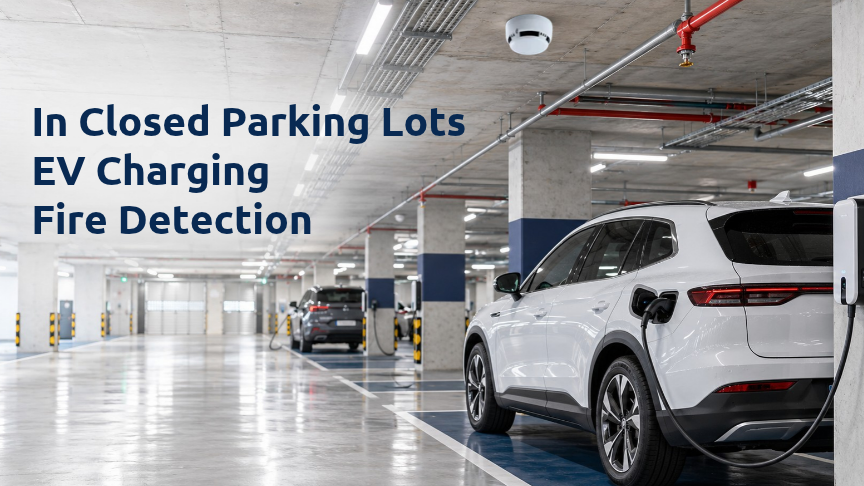
Adding electric vehicle charging points to an enclosed car park is not simply a matter of adding a few detectors or charging units to an existing design. The vehicle battery, EVSE equipment and connections, distribution boards, smoke movement, safe charging shutdown, evacuation and fire-service response should be considered within one coordinated cause-and-effect strategy.
Isolating the charging supply stops charging through the EVSE, but it does not de-energise the vehicle traction battery. Fire safety for EV charging in enclosed car parks therefore requires detection, smoke control, water-based protection, power isolation and post-incident management to be planned together.
|
Source |
Primary concern |
Design question |
|
Vehicle battery |
Thermal runaway, vent gases and re-ignition |
Where will smoke and heat develop, and how will they move through the car park? |
|
EVSE, plug and cable |
Local overheating, arcing, impact and connection faults |
How is the fault detected and how is charging safely stopped? |
|
Distribution board |
Protection, selectivity and isolation |
Which charging group is isolated, under what condition and by whom? |
|
Ventilation / smoke control |
Smoke dilution or redistribution |
How do normal and fire modes affect detector response? |
This approach is not an installation design. Final values should be verified against current legislation, adopted standards, manufacturer instructions, the approved fire strategy and competent engineering calculations.
Before EV charging infrastructure is added, the existing fire-safety baseline of the car park should be documented. Area, basement level, sprinkler and fire-water provisions, mechanical smoke control, existing fire alarm zones, escape routes, fire-service access and electrical distribution should be reviewed together.
The new charging project should identify which parts of the existing strategy change. Charging areas should be clearly represented in the fire alarm system and graphics, while charging groups and feeder boundaries should be defined in the cause-and-effect strategy.
For projects in Türkiye, the current Binaların Yangından Korunması Hakkında Yönetmelik and relevant administrative guidance should be checked. The source document states that Article 60 includes key provisions for enclosed car parks, including automatic sprinkler/fire-water measures above 600 m² and independent mechanical smoke exhaust above 2,000 m². Local authority and project-specific requirements should also be verified.
The source also states that the Regulation contains no provision specific to EV charging stations and that a Ministry opinion letter dated 23 January 2026 considers compliance with the fire measures of the Regulation sufficient for charging stations. This interpretation should be checked in its current form for the actual project.
Point smoke, heat or multi-criteria detectors; beam or aspirating systems; thermal monitoring; gas/VOC sensing and EVSE/EMS telemetry can serve different functions in an enclosed car park. They are not direct substitutes for one another.
Smoke detection may provide early response, but exhaust, dust and airflow should be considered because of nuisance-alarm risk and response time. Heat or multi-criteria detection may suit some contaminated environments, although response may be later.
Beam or aspirating detection may be considered for large or unusual ceiling geometries. Beams, fans, obstructions and maintenance access should be taken into account. Thermal monitoring can provide supplementary warning, but line of sight and alarm thresholds remain important.
Gas or VOC sensing may provide an early indication in some battery venting events. Because battery chemistry, ventilation and sensor selectivity vary, it should not be treated as a universal fire-detection method.
EVSE or energy-management signals such as overtemperature, leakage, fault or charging state may also provide useful technical information. Signal meaning, failsafe behaviour and response to communication faults can vary by manufacturer.
Charging bays should be coordinated with escape routes, pedestrian paths, columns, sprinkler heads, hose cabinets and responder access. Instead of showing only loop and device numbers, addressable labels such as “B2 – EV Charging Bank A” can make incident management easier.
Access to detectors and manual call points should not be obstructed by EVSE impact protection, cable trays or vehicle movement. Detector positions should be reviewed together with supply and extract grilles, jet fans, beams and ceiling pockets.
A manual fire alarm point, EVSE emergency isolation and the fire alarm control panel do not serve the same function. Each should be clearly identified on site. Where graphics or remote monitoring are used, the event message should clearly show the floor, charging bank and isolation scope.
The main integration question is which input operates which output, with what delay and with what reset authority. Where the approved design requires it, a confirmed fire alarm may isolate a defined EVSE group. This action stops the charging supply only; the vehicle traction battery remains on the vehicle.
A confirmed fire alarm may initiate occupant warning, remote notification and shutdown of a selected EVSE group. The isolation scope, latching and reset authority should be clearly defined.
A sprinkler flow signal or approved fire scenario may affect smoke control, EVSE isolation and event transmission. The approved sequence and timing should be preserved.
An EVSE overtemperature or critical fault signal may stop charging and create a technical alarm. Not every EVSE fault is a building fire alarm. Signals should be clearly classified as fire, technical fault or pre-warning.
Manual emergency isolation may disconnect the defined EVSE supply. Unauthorised re-energisation should be prevented and the function clearly labelled. Fan faults may be reported to the fire alarm panel or BMS, and the emergency strategy should consider actual fan status.
Mechanical ventilation can dilute smoke, move it away from a detector or carry it into another zone. Detection should therefore be assessed under both normal ventilation and fire-mode operation.
Where jet fans or mechanical smoke control are used, alarm zones and fan-control zones should be coordinated. Normal and fire modes may produce different detector response times.
High air velocity near a grille can delay local smoke accumulation. Detector placement should be checked against the spacing rules of the adopted standard and manufacturer instructions. If a fan fails, actual smoke movement may differ from the design condition; the fault should therefore be monitored and the system response defined.
The sprinkler and ventilation sequence is another coordination issue. Because airflow may affect activation dynamics, the final sequence should be verified through the approved fire strategy and commissioning tests.
A fire detection system does not extinguish battery thermal runaway. Lithium-ion battery events may continue to generate heat and may re-ignite after initial suppression. Water-based protection, fire-service access, water supply, drainage, contaminated run-off management, smoke control and post-fire vehicle monitoring/removal should therefore be considered together.
The scope, duration and fire-spread objective of water-based protection should be verified against applicable requirements and the approved fire strategy.
Responders should be able to identify the fire alarm panel, EV isolation point and charging area quickly. Drainage and management of potentially contaminated run-off should consider the possibility of extended water application.
A post-fire monitoring and safe vehicle-removal procedure should be established. Portable extinguishing equipment should be selected for incipient non-battery fires according to the risk assessment.
Before the design is finalised, the existing car-park fire strategy, zoning and as-built records should be reviewed. EVSE locations should be coordinated with escape routes, fire-service access, sprinklers and smoke control.
Charging-group feeders and isolation boundaries should be defined, while detector technology and placement should be checked against ceiling geometry, beams and airflow. EVSE/EMS signals should be classified as fire, technical fault or pre-warning.
The cause-and-effect matrix should include alarms, fans, notifications, doors and charging shutdown. The manual isolation point, authority and re-energisation procedure should be documented. Fire-service information should clearly identify EV charging areas and isolation controls.
Post-fire battery monitoring and vehicle recovery should be included in the emergency plan, and commissioning tests should cover both normal and fire-mode ventilation.
|
Test / maintenance item |
Expected evidence |
|
Detector alarm, pre-alarm and fault |
Address/zone, timestamp and panel message |
|
EVSE critical fault / technical alarm |
Signal class, protocol and fire/BMS response |
|
Automatic EVSE isolation |
Affected bank, delay, latch and reset authority |
|
Manual emergency isolation |
Location, label, access and actual disconnection |
|
Smoke control / fans |
Normal/fire mode, feedback and fault status |
|
Sprinkler / fire-scenario interface |
Flow/supervisory signal and cause-and-effect output |
|
Remote monitoring / security desk |
Correct floor, charging bank and event class |
|
Documentation |
As-built, I/O list, matrix, test records and revision history |
Acceptance should not end when devices produce an alarm. The roles of security, technical and management teams in alarm, isolation and evacuation should also be verified through scenario testing.
No, not as a universal rule. Detector type, quantity and position should be determined from the adopted standard, ceiling geometry, airflow and documented risk assessment.
There is no single answer. Smoke detection may provide earlier warning, while exhaust, dust and airflow can increase nuisance-alarm risk. Heat or multi-criteria detection may be considered according to environmental conditions.
Selected manufacturer signals may be integrated as supplementary technical alarms. Each signal should be clearly classified and tested as fire, technical fault or pre-warning.
It may, where the approved cause-and-effect strategy requires it. The isolation scope, delay, latching and reset authority should be defined.
No. Disconnecting the charger or its supply stops charging, but the vehicle traction battery remains installed and may remain energised.
Yes. Fans may dilute or relocate smoke. Detection should be assessed and tested under both normal and fire ventilation modes.
Generally no. Thermal monitoring can provide supplementary temperature warning; replacement of the fire-detection function requires verification under the adopted standard and approved fire strategy.
Not always. Lithium-ion batteries may re-ignite. Post-fire monitoring, a safe holding location and a vehicle-removal procedure should be planned.
The current Binaların Yangından Korunması Hakkında Yönetmelik, relevant administrative guidance, electrical-installation requirements, local fire-authority conditions and the standards adopted for the project should be verified together.
EV charging infrastructure in an enclosed car park requires fire safety and electrical engineering to be considered together. A robust design combines detection and zoning, smoke control, selective EVSE isolation, water-based protection, notification, evacuation and responder access in one testable cause-and-effect plan.
The approach should not rely on one detector rule, but on a risk-based and verifiable design. After handover, the system should continue to be managed through maintenance, change control and emergency procedures.
• Binaların Yangından Korunması Hakkında Yönetmelik (Türkiye) — özellikle Madde 60, kapalı otopark hükümleri: https://www.mevzuat.gov.tr/
• T.C. Çevre, Şehircilik ve İklim Değişikliği Bakanlığı, Yerel Yönetimler Genel Müdürlüğü — Görüş: Elektrikli araç şarj istasyonlarının ruhsatlandırılmasında aranan yangın tedbirleri hk., 23.01.2026 tarihli ve E-14399437-045.02-14291808 sayılı yazı (12.02.2026 tarihinde yayımlanan nüsha): https://webdosya.csb.gov.tr/v2/yerelyonetimler/2026/02/Elektrikli-ara-arj-ist-20260212172424.pdf
• IEC 60364-7-722:2018 — Low-voltage electrical installations, Supplies for electric vehicles: https://webstore.iec.ch/en/publication/29958
• IEC 61851-1:2017 + COR1:2023 — Electric vehicle conductive charging system, General requirements: https://webstore.iec.ch/en/publication/33644
• UK Office for Zero Emission Vehicles — Covered car parks: fire safety guidance for electric vehicles (published 2023, updated 08.02.2024): https://www.gov.uk/government/publications/covered-car-parks-fire-safety-guidance-for-electric-vehicles
• EN 54 series — Fire detection and fire alarm system component standards; applicable parts and current editions to be verified for the selected architecture.
 TR
TR