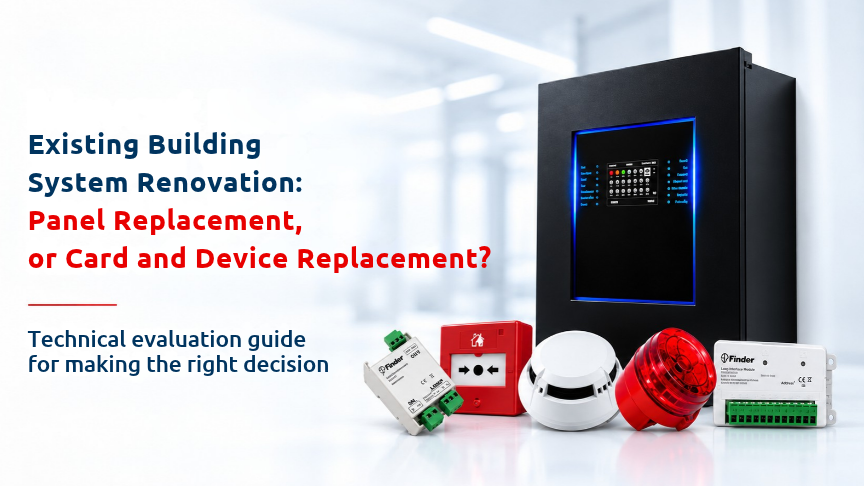
Base a fire detection and alarm retrofit decision on compatibility, risk, supportability and life-cycle cost—not on the number of faults.
|
Short answer |
|
Option |
When it may be preferred |
Primary risk |
|
Panel replacement only |
Field wiring and devices have been verified and are documented as compatible with the new panel |
Legacy device/protocol incompatibility |
|
Board/module replacement |
The panel platform is current and manufacturer support and capacity are adequate |
A temporary solution becoming permanent |
|
Field-device replacement |
The panel is healthy but detectors, call points, modules or alarm devices are ageing or incompatible |
Managing mixed device generations |
|
Complete system replacement |
End of support, widespread faults, capacity shortfall or undocumented compatibility |
Unplanned outage and higher initial investment |
A problem that appears to be a panel fault may actually originate from the field circuit, power supply, batteries, environmental conditions, earthing or legacy devices. Before replacing any single component, prepare an inventory of the existing installation.
Panel make/model, software version, boards and peripheral list
Number of loops/zones, utilisation ratio, address plan and spare capacity
Quantities of detectors, manual call points, sounder/beacons, input/output modules and isolators
Cable type, circuit topology, insulation/earth faults and measurement results
Power-supply load calculation, battery age and actual standby performance
Fault, false-alarm, maintenance and replacement records from the previous 12–24 months
Lift, HVAC, smoke-control, door-holder and supervisory-system interfaces
|
Critical rule |
|
Criterion |
Key question |
Retrofit signal |
|
Support |
Are manufacturer support and spare parts still available? |
Parts are unavailable or repair times are increasing |
|
Compatibility |
Is documented compatibility available for new and legacy components? |
Adapter-based or assumption-based integration |
|
Capacity |
Is there adequate expansion and spare capacity? |
Operating close to loop/zone and power limits |
|
Reliability |
Are faults or false alarms recurring? |
The same root cause reappears |
|
Records |
Are event history and remote-monitoring needs adequately supported? |
Insufficient logs, reporting or diagnostics |
|
Integration |
Can cause-and-effect outputs be tested safely? |
Undocumented relay logic or temporary workarounds |
|
Life cycle |
What is the five-year total cost? |
Maintenance and outage costs exceed the investment difference |
Consider when the existing panel is unsupported, undersized or has limited event-recording or integration capability.
Do not proceed until documented compatibility with field devices, circuit quality and power calculations have been verified.
May be suitable when the fault is isolated to a specific power supply, loop board, communication board or user interface.
If the platform has limited remaining life, board replacement should be treated only as part of a controlled migration plan.
Consider where contamination, ageing, a high false-alarm rate, unsuitable detector selection or device-supply problems are significant.
During phased replacement, addressing, labelling, sensitivity settings and compatibility between device generations should be managed.
May be the lowest-risk route where faults are widespread, support has ended, component combinations are undocumented, capacity is insufficient or the building has materially changed.
Phased commissioning should be planned so that building protection is maintained continuously as far as possible.
|
Step |
Yes |
No |
|
Is the panel platform still supported by the manufacturer? |
Continue with capacity and fault analysis |
Prioritise complete replacement |
|
Has the problem been isolated to a single board/module? |
Compare board replacement against life-cycle cost |
Investigate the root cause in the field/circuit |
|
Are existing devices documented as compatible with the new solution? |
Phased migration is possible |
Replace the devices as well |
|
Is the five-year total cost advantageous? |
Controlled partial retrofit |
Plan complete replacement |
|
Procurement note |
Approved existing-condition and revision drawings have been compared.
High-risk areas and periods during which the system will be out of service have been identified.
Temporary fire-watch and emergency communication procedures have been documented.
Rollback steps, backup files and responsible persons have been defined.
Every cable and device has been labelled and photographed before disconnection.
Insulation, continuity and loading checks have been carried out by loop/zone.
The cause-and-effect matrix has been transferred to the new system under controlled revision management.
Battery and power-supply calculations have been updated for the final configuration.
All detectors, manual call points, alarm devices and modules have been functionally tested.
Lift, HVAC, door, extinguishing and monitoring interfaces have been verified by scenario.
Fault, short-circuit, open-circuit and mains-failure conditions have been tested.
As-built drawings, device lists, configuration backups, test records and user training have been delivered.
Compatibility declaration and relevant product/certification documents
Clear list of exclusions and assumptions
Phasing plan, downtime and temporary safety measures
Warranty, spare-parts lead time and technical-support model
Optional unit rates and five-year maintenance cost
|
Conclusion |
Should the fire alarm system in an existing building be fully replaced, or can a partial retrofit be sufficient?
There is no universal choice. If the panel platform remains supported and technically adequate, controlled board or field-device replacement may be suitable. A complete system replacement may be considered where protocol compatibility, spare parts, capacity or integration requirements cannot be met.
When should only the fire alarm control panel be replaced?
Panel replacement may be considered when the existing panel is unsupported, undersized or lacks the event-recording and integration capabilities required by the project. Documented compatibility with existing field devices, cable condition and power calculations should be verified.
When can replacing only a board or module be sufficient?
Board or module replacement may be suitable when the fault has been conclusively isolated to a power supply, loop board, communication board or user interface. If the platform has limited remaining life, the replacement should form part of a controlled migration plan.
When should field devices be replaced?
Field-device replacement may be considered where contamination, ageing, high false-alarm rates, unsuitable detector selection or device-supply problems are significant.
How should compatibility between a new panel and existing field devices be verified?
Physical connection alone is not proof of compatibility. Protocol, firmware, power consumption, short-circuit isolator behaviour, input/output functions and certification scope should be confirmed through manufacturer documentation.
What should be reviewed before deciding on a fire alarm retrofit?
The review should cover the panel model and software, loop and zone structure, spare capacity, field devices, cable topology, insulation and earth faults, power-supply and battery condition, the previous 12–24 months of faults and false alarms, and interfaces such as HVAC, lifts, doors, extinguishing and monitoring systems.
How should building protection be maintained during a fire alarm retrofit?
High-risk areas and outage periods should be identified in advance, and temporary fire-watch and emergency communication procedures should be prepared. Phased commissioning should be planned so that building protection is maintained as far as possible throughout the work.
What information should be requested in a fire alarm retrofit quotation?
The quotation should include documented compatibility, applicable product and certification documents, exclusions and assumptions, phasing, downtime, temporary safety measures, warranty, spare-parts lead time, technical support, optional unit rates and a five-year maintenance cost view.
T.C. Mevzuat Bilgi Sistemi — Binaların Yangından Korunması Hakkında Yönetmelik: https://www.mevzuat.gov.tr/
European Commission — Construction Products Regulation overview: https://single-market-economy.ec.europa.eu/sectors/construction/construction-products-regulation-cpr_en
EN 54 series — applicable product and system requirements should be confirmed from the current licensed standard and manufacturer certification documents.
Finder product datasheets, compatibility lists, commissioning manuals and project-specific cause-and-effect matrix (current revisions).
 TR
TR