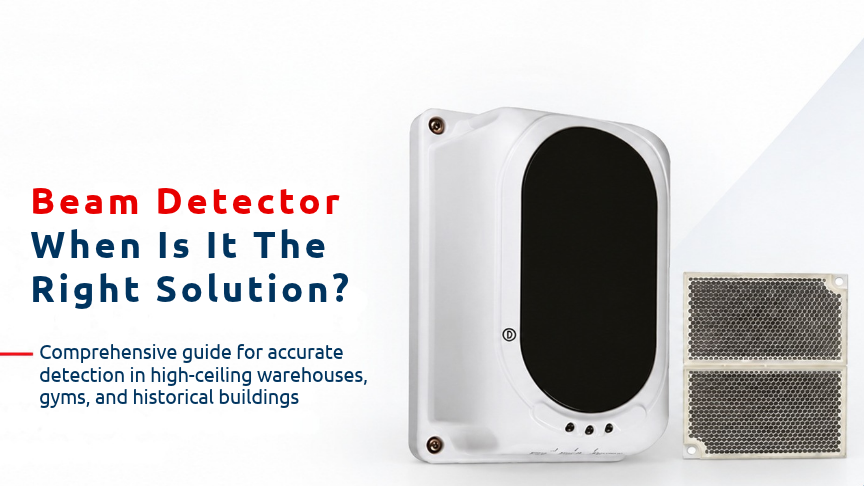
A beam, or line-type smoke detector, can be a strong detection solution in large, open and high spaces where a continuous sight line can be established, smoke is expected to reach the selected beam level, and structural movement and contamination can be managed.
However, a high ceiling alone is not sufficient reason to select beam detection. If racks, banners, cranes, sports equipment, roof trusses or architectural elements frequently obstruct the optical path, or if smoke stratification, heavy dust, condensation or maintenance access cannot be resolved, another detection technology should be considered.
The fundamental design principle is not simply “fewer devices for a high ceiling.” The optical path, smoke movement, structural behaviour, coverage geometry, panel compatibility, commissioning and maintenance should be considered together.
|
Question |
If yes |
If no |
|
Is the volume large and open? |
Beam may be advantageous |
Review point or aspirating options |
|
Is there a continuous sight line? |
The optical path can be planned |
High obstruction risk |
|
Will smoke reach the beam level? |
Detection may be possible |
Stratification analysis is required |
|
Is the mounting surface stable? |
Alignment can be maintained |
Structural movement should be resolved |
|
Is testing and cleaning access available? |
Lifecycle maintenance is manageable |
Alternative technology or access solution is needed |
A line-type smoke detector monitors attenuation and changes in the optical path between a transmitter and receiver, or between a unit and a reflector. When smoke enters the beam path, the received optical energy decreases. The approved device algorithm evaluates this change as normal, alarm or fault.
In an opposed transmitter–receiver arrangement, the optical path is between two active ends and may require power, cabling and access at both ends. In a reflective system, the beam returns from a reflector on the opposite surface. A single active end may simplify installation, but the complete outward and return optical path must remain clear.
Motorised or automatic alignment may correct the optical axis within the permitted capabilities of the product. It should not be assumed to compensate for unlimited structural movement.
A point detector evaluates smoke entering its own sensing chamber, while a beam detector observes the overall effect of smoke along a defined optical path. This may provide an advantage in large open spaces, but it does not mean that smoke outside the beam path will automatically be detected.
Smoke can attenuate the beam gradually and partially. A forklift, ball, bird, banner or platform may interrupt it suddenly and strongly. Product algorithms may attempt to distinguish these conditions, but persistent obstruction, contamination or alignment loss can still create faults or unwanted conditions.
Beam detection can be considered in high and open spaces where a long and stable optical path can be established. A large floor area, clear sight line, rigid mounting surfaces, test and adjustment access and manageable contamination all support the technology choice.
High ceilings may be difficult to access and may allow a long optical path, but whether smoke will actually reach the beam level still needs to be assessed. A large open floor may benefit from line detection, while coverage geometry and the possible need for multiple beams remain project-specific.
A clear sight line helps maintain stable optical energy. Future changes to racks, equipment, temporary installations and room use should therefore be considered, not only the conditions present on the installation date.
Rigid mounting surfaces help preserve alignment, but deflection, vibration and thermal movement should be assessed. Remote test or adjustment functions may help maintenance, but they do not eliminate the need for physical inspection and cleaning access.
Two buildings with the same ceiling height may produce completely different decisions. An open sports hall may provide a stable optical line, while a warehouse of the same height with moving racks may repeatedly obstruct the beam.
Beam smoke detection provides line detection across large, open high spaces, but sight line, alignment and stratification are its key limitations.
Point smoke detection offers local and easily understood coverage, although access and detection delay should be considered at high ceilings. Aspirating detection can provide multiple sampling points and very early detection options, but requires pipe calculations, transport-time considerations, filtration and maintenance.
Flame detection can provide line-of-sight detection for rapidly flaming risks, but fuel spectrum and unwanted radiation sources need consideration. Heat detection may be more robust in normally dusty or smoky environments, but generally responds later than smoke detection.
Beam technology should therefore not be selected only on device quantity or installation convenience. Fire risk, geometry, smoke movement, environmental conditions and maintenance should be evaluated together.
High ceilings, large air volumes and long aisles can make beam detection attractive in warehouses. Rack height, changing storage, forklift routes, roof trusses, sprinkler pipework, cable trays, smoke-control arrangements and HVAC should still be reviewed together.
High racks may trap smoke or obstruct the optical path. Rack-top and aisle geometry should therefore be assessed together with any requirement for supplementary detection. If stock height changes over time, a clear beam path at commissioning may later become obstructed. The maximum rack and stock envelope should therefore be defined in the design.
Forklift or crane movement can cause temporary or persistent obstruction. The beam should be kept away from movement corridors where possible. A hot layer beneath the roof can cause smoke stratification, requiring section analysis and possibly different beam levels.
Dust can contaminate optical surfaces and affect maintenance intervals. Doors and fans can also redirect smoke.
Warehouse design should consider maximum future rack and pallet height, the beam position relative to the fire load, interference from sprinklers and roof elements, the effect of smoke-control fans, safe access to both ends and whether in-rack or aspirating supplementary detection is needed.
A common mistake is designing the beam path for an empty warehouse. If the maximum permitted storage envelope is ignored, the beam may become blocked after the building is put into use.
Large spans in sports halls may provide suitable beam geometry, but balls, scoreboards, curtains, stage trusses, retractable hoops, acoustic panels, banners and temporary decorations can change the optical path.
The detector and reflector should be positioned outside impact paths. Every operating position of retractable hoops and curtains should be checked. For scoreboards and trusses, future equipment envelopes should be considered in addition to current conditions.
If the space is also used for concerts, exhibitions or ceremonies, temporary stages, lighting, decoration and theatrical fog should be included in the fire-detection change-control procedure. The optical path and normal system state should be checked before events.
Roof vibration may affect mounting rigidity and alignment tolerance. Manufacturer orientation and optical limitations should be applied for daylight and strong direct light.
In heritage buildings, reducing the number of visible devices and cables, limiting intervention in decorative finishes and avoiding difficult access to high vaults may support beam detection.
Irregular geometry, thick walls, vibration, sunlight, high vaults and conservation restrictions still require specific coordination. The product should not be painted or physically altered unless explicitly permitted by the manufacturer.
High vaults may benefit from optical monitoring, but stratification and sloped or multi-level ceiling geometry should be assessed. Remote adjustment or testing may help in difficult-access areas, while cleaning and physical inspection access must still be maintained.
The fire-safety design should be developed with the architect, conservation specialist, electrical and mechanical teams, relevant authority and manufacturer requirements.
A frequently changing sight line, unstable mounting surfaces, heavy dust, steam or condensation, strong direct light, smoke stratification, complex ceiling geometry or lack of safe maintenance access can limit beam detection.
If racks, cranes, banners or doors repeatedly obstruct the beam, another path, level or detection technology should be considered. If deflection, vibration or thermal movement affects alignment, a structural solution or alternative detection method may be required.
Stratification is particularly important. Rising smoke mixes with surrounding air. If a hot air layer exists at high level, smoke may spread horizontally before reaching the ceiling and remain below a beam installed near the roof.
The design should therefore consider the expected fire size, space temperature profile, HVAC operation and smoke-control modes.
For sloped, vaulted, saw-tooth or stepped roofs, plan-view beam length alone is not enough. Beam elevation and the smoke path in each roof section should also be assessed.
CFD or smoke testing can support engineering decisions but does not replace the applicable design standard, product documentation or authorised fire strategy.
The approved operating range of the selected product, beam level, lateral coverage, mounting-surface rigidity, deflection and vibration, complete sight line, receiver or reflector orientation, direct-light exposure and maintenance access should be checked together.
Coordination drawings should show the transmitter–receiver or unit–reflector axis and elevation, the complete beam route in plan and section, maximum rack and stock envelopes, trusses, ducts, cable trays, luminaires, sprinklers and moving equipment.
Maintenance access, safe working method, cable, interface, loop or zone and panel address should also be documented.
In long-span steel buildings, day–night temperature changes, wind and snow loads can change the angle between opposite surfaces. Mounting should therefore consider expected lifecycle movement, not only initial alignment.
Mounting on vibrating cladding or lightweight secondary framing is a common error. Even if the detector itself is rigid, a moving support surface can make the optical axis unstable.
Commissioning is not simply confirming that the device shows “normal.” Optical path, alignment, alarm and fault response, panel text, cause-and-effect functions and baseline values should be documented.
Visual inspection covers the optical path, mounting, cabling and physical damage. Alignment is performed according to the manufacturer procedure and the signal or setting is recorded.
Alarm testing should use the manufacturer-approved filter, tool or procedure. The fault function should be verified separately using the manufacturer-defined obstruction or fault method.
At the panel and interface, address, zone and event text should match the actual location. Sounders, transmission and control outputs should operate according to the approved cause-and-effect scenario.
The baseline signal level, configuration, date and responsible person should be recorded. Final beam axis, elevation, product and cable details should be included in the as-built documents.
Randomly blocking the beam with a hand, cloth or cardboard may create a fault rather than an alarm. Alarm and fault functions should therefore be tested separately with the approved method.
Beam-detector suitability does not end at commissioning. Optical surfaces, sight line, mounting, signal and alignment, alarm and fault operation and records should be inspected periodically.
Gradual signal loss may indicate contamination, partial obstruction or alignment drift. A sudden fault may be caused by complete obstruction, power or cable problems or significant structural movement. Seasonal recurrence may indicate thermal movement or condensation. Event-related issues may involve trusses, banners, curtains or fog.
Signal and alignment trends should be checked through the first seasonal transition. Rack, decoration or equipment changes should trigger an optical-path check. Repeated alarm or fault events should not simply be reset; contamination and structural movement should be investigated.
Whenever storage arrangement, structure, HVAC, smoke control or room use changes, beam suitability should be reassessed.
|
Criterion |
Favours beam |
Against beam |
|
Geometry |
Large, open, long sight line |
Compartmented or complex volume |
|
Ceiling |
High and difficult to access |
Smoke does not reach beam level |
|
Obstructions |
Fixed and predictable |
Frequently changing equipment |
|
Structure |
Rigid mounting surfaces |
High movement or vibration |
|
Environment |
Manageable contamination |
Heavy dust, steam or condensation |
|
Maintenance |
Remote functions plus physical access |
No safe access |
|
Operations |
Strong change control |
Uncontrolled temporary fit-out |
|
Integration |
Approved compatibility |
Unclear interface or approval |
Beam detection is appropriate when the sight line remains clear, smoke reaches the selected level, the mounting is stable and maintenance is achievable. If any of these conditions cannot be resolved, the technology choice should be reconsidered.
What is a beam smoke detector?
A line-type detector that monitors smoke attenuation along an optical path between opposed components or a unit and reflector.
Why use beam detection at high ceilings?
It can provide line detection across a large open volume where high-level access for many point detectors is difficult.
Is beam detection suitable for every high ceiling?
No. Sight line, stratification, structural movement, contamination and maintenance access must all be assessed.
What is the difference between reflective and transmitter–receiver types?
Reflective systems return the beam and commonly use one active end; opposed systems have separate transmitter and receiver. Exact architecture is product-specific.
Is one beam enough for a racked warehouse?
Not always. Rack geometry, smoke movement, fire load and applicable rules may require supplementary detection.
Does smoke stratification affect a beam detector?
Yes. Smoke may spread below the beam level, delaying response; other levels or technology may be needed.
How is a beam detector tested?
Use the manufacturer-approved filter, tool or procedure and verify alarm and fault functions separately.
Does a beam detector require maintenance?
Yes. Inspect optics, sight line, mounting, signal and alignment, alarm and fault operation and records.
Can beam detection be used in heritage buildings?
It may reduce visible mounting points, but conservation approval, cable routing, geometry and access must be coordinated.
What range and ceiling distance should be used?
There is no universal value. Use the approved product documentation and the applicable project design standard.
A beam detector is not an automatic answer to a high ceiling. It becomes a strong method when the optical path can remain clear, smoke is expected to reach the selected beam level, mounting surfaces are stable and testing, cleaning and maintenance are achievable.
For high-bay warehouses, sports halls and heritage buildings, the decision should be based not only on product range but also on smoke movement, stratification, structural behaviour, obstructions, operational changes and lifecycle maintenance.
Exact range, beam elevation, lateral spacing, sensitivity, environmental class, automatic alignment, test method and panel compatibility should be verified using the current datasheet, DoP/certificate scope, installation instructions and applicable project standard for the actual Finder beam detector selected.
 TR