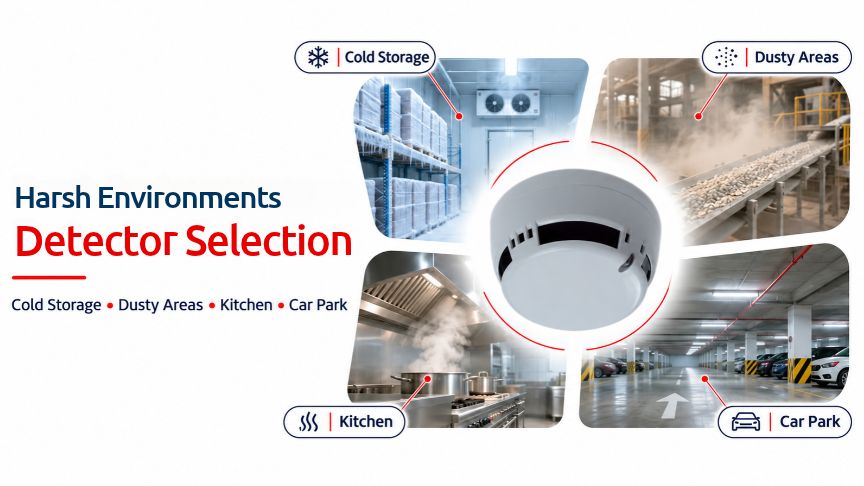
Selecting the right detector for a challenging environment is not simply about finding the device that reacts earliest to a fire. The correct solution must distinguish the expected fire signature from normal steam, dust, exhaust, strong airflow, rapid temperature change and humidity while operating within its approved environmental limits and remaining maintainable. Condensation is critical in cold stores, particulates in dusty production, grease aerosols in kitchens and airflow in open car parks.
Who is this guide for?
Dealer and distributor technical teams
Fire detection design engineers and installers
Cold-store, factory, commercial-kitchen and car-park operators
Commissioning, maintenance and technical service teams
A detector strategy developed for a clean office should not be copied directly into a demanding industrial or environmental application.
The same fire scenario can produce very different detector behaviour in different environments.
An optical smoke detector may provide a fast response in a clean space but become more susceptible to contamination or nuisance alarms where heavy dust, steam or aerosols are present.
A heat detector may tolerate these effects better, but it can react later than smoke detection during a slow-developing, low-heat fire.
Selection should therefore begin with four questions:
Is the earliest expected fire signature smoke, heat or flame?
Which normal non-fire phenomena can resemble a fire?
Are the detector's temperature, humidity, corrosion, dust and water-ingress limits suitable?
Can the maintenance team access, monitor and test the device realistically?
The objective is not to suppress nuisance alarms by making the detection system blind. The objective is to understand the normal process load and select a detection architecture capable of distinguishing it from the target fire signature.
Point optical smoke detectors can provide early warning for many smoke-producing fires. However, dust, steam, aerosols and strong airflow may contaminate the optical chamber, create non-fire signals or delay smoke transport.
Point heat detectors can provide a more tolerant approach where optical contaminants are significant. However, they do not detect the smoke phase, so the selected temperature class must suit both the normal environmental temperature and the target fire scenario.
Smoke + heat multi-sensor detectors can evaluate more than one parameter when determining whether a fire condition exists. They are not an automatic solution for every challenging environment; the algorithm, operating mode and manufacturer application limits still require verification.
Aspirating smoke detection can provide flexible sampling arrangements in difficult-to-access spaces or areas with strong airflow. Filtration, pipe design, condensation management, sampling-point calculations and maintenance then become critical design issues.
Line-type heat detection can provide robust monitoring for long routes, cable runs and some dirty or humid environments. Temperature class, zoning and risk of physical damage must be assessed.
Flame detection can react very quickly in special processes where open flame develops rapidly, but line of sight and false radiation sources need specific consideration. It should not be treated as a general-purpose area detector.
|
Technology |
Main strength |
Main environmental check |
|---|---|---|
|
Optical smoke |
Early warning for many smoke-producing fires |
Dust, steam, aerosols and airflow |
|
Point heat |
More tolerant of optical contamination |
Ambient temperature and correct class |
|
Multi-sensor |
Verification using multiple parameters |
Algorithm and application mode |
|
Aspirating smoke |
Flexible detection in difficult-access/high-airflow areas |
Filter, pipework, condensation, maintenance |
|
Line heat |
Robust for long runs and some dirty/humid areas |
Class, zoning and physical damage |
|
Flame |
Rapid response in specific open-flame risks |
Line of sight and false radiation |
Cold-store design should not be based only on a thermometer value.
Evaporator fans can change the natural movement of smoke toward the ceiling, while door opening and defrost cycles may create short-term changes in temperature and humidity.
The detector head, base, cable entries and associated accessories must all remain suitable under the actual operating conditions.
A low minimum operating temperature on a data sheet is not sufficient by itself.
Humidity, rapid thermal change, condensation, icing and accessory compatibility must also be verified. Evaporator airflow, high racking and ceiling geometry should be considered together with smoke movement.
Devices should not simply be positioned directly in evaporator discharge without assessing the actual airflow pattern.
Where aspirating detection is considered, condensation at transitions between cold and warmer areas should be addressed.
Sampling holes, pipe temperature and filter maintenance should be verified using the manufacturer's design methodology.
Where alarm verification or multi-sensor logic is used, the effect of any resulting delay on the target fire scenario should be measured during acceptance testing.
Maintenance access must also be practical. Testing and cleaning in iced or high-racking areas require safe access planning.
Woodworking, textile, food, cement, metal-processing and packaging operations may create continuous airborne particulates.
Dust entering an optical chamber can consume contamination compensation, influence sensitivity or create signals that resemble smoke.
The type and level of dust should therefore be characterised:
Is it continuous?
Does it increase during particular shifts?
Is it conductive or corrosive?
Does cleaning re-suspend it into the air?
Optical smoke, heat, multi-sensor, filtered aspirating or line-heat approaches should be compared against the expected fire profile.
For filtered or aspirating systems, maintenance indicators and realistic filter-change intervals need to be planned.
Compressed-air cleaning can temporarily create very high particulate concentrations, so the alarm strategy should account for this condition. Maintenance frequency should be based on real contamination trends rather than copied from an office environment.
The objective is not to solve nuisance alarms simply by reducing sensitivity. The normal process particulate load should be understood and separated from the expected fire signature.
Where combustible dust may create an explosive atmosphere, another distinction is essential: fire detector selection and hazardous-area equipment suitability are not the same issue.
Where ATEX/IECEx or other project-specific hazardous-area requirements apply, they should be assessed separately by appropriately competent specialists.
Normal cooking can create steam, grease aerosols and rapid temperature changes, particularly around cooking appliances.
These phenomena may cause unwanted alarms for optical smoke detection located too close to the source.
However, moving detection too far away simply to reduce nuisance alarms can create another problem: delayed detection of a real fire.
Blanket rules such as “always use heat in a kitchen” or “multi-sensor solves every problem” should therefore be avoided.
The cooking line, hood airflow, ceiling height, grease accumulation and target fire scenario should be assessed together.
Where smoke detection is used, normal steam and aerosol movement should be observed under real operating conditions.
For heat detection, the selected class should avoid alarms during normal cooking while providing acceptable response to the target fire.
For multi-sensor detection, the manufacturer's application mode or algorithm should be verified.
Hood suppression, gas or energy isolation and the general fire alarm should be treated as separate functions in the cause-and-effect matrix and tested end to end.
Cleaning chemicals and heavy steam during maintenance can also act as nuisance-alarm sources.
In open or naturally ventilated car parks, wind, vehicle movement and large openings can prevent a stable smoke layer from forming at ceiling level.
Exhaust, road dust, humidity, wind-driven rain and a wide temperature range can also affect equipment reliability.
The first step is to determine whether the car park is genuinely open-sided, partially open or an enclosed space using mechanical smoke control.
Opening ratios and actual airflow can significantly change how quickly and in which direction smoke reaches a sensor.
Where jet fans or mechanical ventilation are installed, the effect of the fire-mode operation on detection should be verified through the cause-and-effect strategy.
Depending on the project, point heat, line heat, multi-sensor, aspirating, video or flame detection may be considered.
There is no universal “best detector” for an open car park.
The selection must consider:
expected fire signature,
airflow,
environmental exposure,
smoke-control strategy,
authority requirements.
Moisture, wind-driven rain and corrosion can also affect bases, insulation and cable entries. An IP rating alone does not demonstrate suitability for every environmental condition.
|
Environment |
Initial approach to evaluate |
Essential verification |
|---|---|---|
|
Cold store |
Low-temperature smoke, heat or aspirating options |
Condensation, evaporator airflow, defrost |
|
Dusty production |
Heat, multi-sensor, filtered aspirating and other options |
Dust, contamination, maintenance, hazardous-area need |
|
Kitchen |
Heat or appropriate multi-sensor; local smoke where justified |
Steam, grease aerosols, hood airflow |
|
Open car park |
Heat, line heat or other project-specific technologies |
Wind, environmental exposure, smoke control |
This table is an initial design guide and does not replace an application-specific engineering design.
The normal temperature, humidity and air-velocity ranges of the protected area should be recorded.
Normal non-fire phenomena such as steam, dust, exhaust, aerosols and rapid thermal change should be listed, while the expected fire signature should be defined as smoke, heat, flame or a combination.
Environmental limits for detectors, bases and accessories should be verified using current manufacturer documentation.
Fans, hoods, evaporators, jet fans, doors and natural openings should be shown on the detection plan. The effect of beams, racking and machinery on smoke transport or line of sight should be reviewed.
The selected technology or operating mode should be justified against nuisance-alarm sources.
Address and zone naming should be understandable to operators and responders.
Safe maintenance access, testing methods and contamination/filter monitoring should be planned.
Any hazardous-area classification should be verified separately.
Suppression, HVAC, energy isolation and process shutdown functions should be included in the cause-and-effect matrix.
Commissioning tests should represent real operating conditions, and as-built drawings and baseline maintenance values should form part of handover.
A detector choice is only complete when its performance is verified at the real site.
Commissioning should confirm the detector address, zone information, panel alarm and any remote alarm indication.
System behaviour should also be observed during fan operation, defrost, cooking, cleaning or intensive production.
Baseline contamination, filter requirements and cleaning intervals should be recorded.
Real temperature and humidity records should be compared with equipment operating limits.
HVAC, hood, suppression, energy/process shutdown and notification functions should be tested end to end.
Safe testing and cleaning of detectors or sampling points should be demonstrated.
Nuisance alarms, faults, contamination and sensitivity trends should then be reviewed in maintenance reports so that service intervals can be adjusted to actual environmental conditions.
Common mistakes include:
Copying an office detector type directly into a harsh environment.
Looking only at the IP rating while ignoring temperature, condensation, airflow and contamination.
Trying to solve nuisance alarms only by reducing detector sensitivity.
Treating kitchen steam, factory dust or car-park exhaust as exceptions rather than design inputs.
Failing to plan filter and condensation maintenance for aspirating systems.
Designing detector positions independently from evaporator, hood or jet-fan airflow.
Confusing hazardous-area suitability with fire-detection standard compliance.
Limiting commissioning to a test spray or heat tool without observing real process conditions.
Failing to adapt maintenance intervals to actual contamination trends.
Assuming EN 54 product compliance automatically proves panel-device system compatibility.
No.
Compliance with the relevant product standard is important, but it is not sufficient by itself for final selection.
Within the EN 54 family:
point smoke detectors are addressed by EN 54-7,
point heat detectors by EN 54-5,
smoke + heat multi-sensor detectors by EN 54-29,
aspirating smoke detectors by EN 54-20,
line-type heat detectors by EN 54-22.
Compatibility and connectability of system components should also be verified separately.
Final selection should combine risk assessment, current project standards, authority requirements, manufacturer operating limits and Finder system compatibility.
For any specific Finder model, temperature/humidity limits, IP rating, accessory compatibility and panel compatibility should be checked against current technical documentation.
Detector selection in a challenging environment is not a search for the “most sensitive” device.
The objective is to create a detection architecture that responds early enough to the target fire while remaining stable during normal process conditions, operating within environmental limits and remaining maintainable and testable.
Condensation and airflow are key issues in cold stores; particulate loading and contamination in dusty production; steam, grease aerosols and hood airflow in kitchens; and wind, exhaust, moisture and temperature variation in open car parks.
For Finder projects, the final decision should combine risk assessment, relevant EN 54 product compliance, system compatibility, actual site conditions and a sustainable maintenance strategy.
Scope: This article is not an application design for a specific model, detector quantity, spacing, alarm threshold or IP rating. Current legislation, project standards, authority requirements and manufacturer documentation should govern the final design.
Can smoke detectors be used in cold stores?
Yes, where temperature, humidity/condensation, airflow and manufacturer application limits are suitable. Aspirating or heat detection may be better in some spaces; the decision depends on risk and geometry.
Will optical smoke detectors false alarm in dusty factories?
They can. Dust may contaminate the optical chamber or create smoke-like signals. Alternative technologies, filtration and maintenance frequency should be assessed together.
Must a commercial kitchen always use heat detectors?
No. Heat is common, but the correct choice depends on steam, grease aerosols, hood airflow, ceiling height and the target fire scenario.
Do smoke detectors not work in open car parks?
That statement is too absolute. High airflow can make smoke transport unreliable, so the real openings, wind, smoke movement and applicable standard must be evaluated.
Does a multi-sensor detector eliminate nuisance alarms?
No. Multi-sensor logic can improve discrimination, but application mode, location, environmental limits and maintenance still matter.
Does IP65 mean a detector is suitable for every harsh environment?
No. IP addresses specific solid and water ingress conditions. Temperature, condensation, corrosion, chemicals, UV, vibration and system compatibility still require verification.
Is aspirating smoke detection always best for cold or dusty areas?
No. It can offer advantages, but only where pipe design, filtration, condensation control, airflow and maintenance are appropriate.
Is EN 54 compliance alone enough to select a detector?
No. Product-standard compliance is important, but system compatibility, environmental limits, project standards and installation conditions must also be verified.
 TR